Renewed Motion to Compel (ECF 33)

Isaac v. Manning et al., No. 6:25-cv-01159-MC (D. Or.) is a federal civil-rights lawsuit against James Ivory Manning Jr., Shelly Boshart Davis, Renee Perry, and Doe defendants, filed in the U.S. District Court for the District of Oregon on July 3, 2025.
Docket Text:
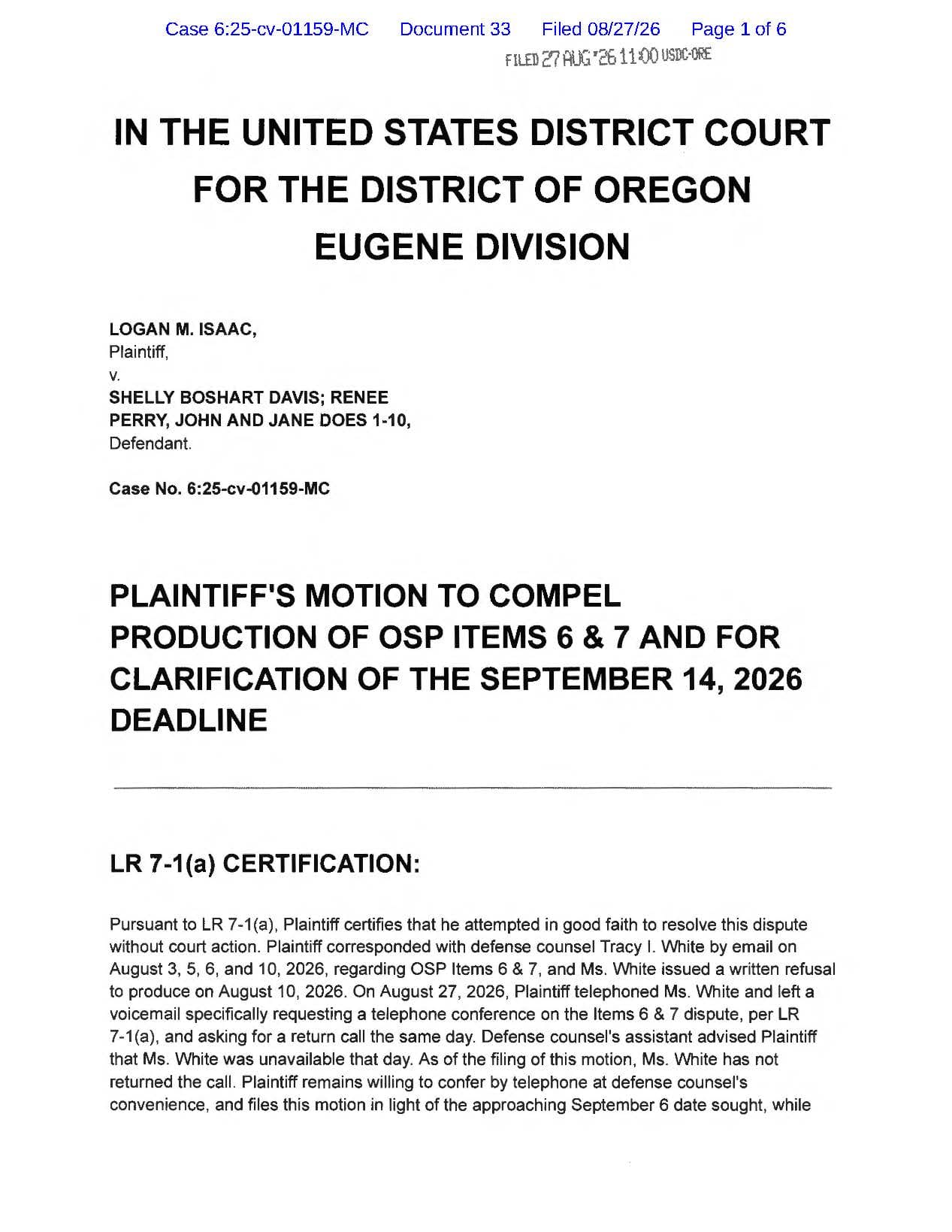
PLAINTIFF'S MOTION TO COMPEL PRODUCTION OF OSP ITEMS 6 & 7 AND FOR CLARIFICATION OF THE SEPTEMBER 14, 2026 DEADLINE
LR 7-1(a) CERTIFICATION:
Pursuant to LR 7-1(a), Plaintiff certifies that he attempted in good faith to resolve this dispute without court action. Plaintiff corresponded with defense counsel Tracy I. White by email on August 3, 5, 6, and 10, 2026, regarding OSP Items 6 & 7, and Ms. White issued a written refusal to produce on August 10, 2026. On August 27, 2026, Plaintiff telephoned Ms. White and left a voicemail specifically requesting a telephone conference on the Items 6 & 7 dispute, per LR 7-1(a), and asking for a return call the same day. Defense counsel's assistant advised Plaintiff that Ms. White was unavailable that day. As of the filing of this motion, Ms. White has not returned the call. Plaintiff remains willing to confer by telephone at defense counsel's convenience, and files this motion in light of the approaching September 6 date sought, while noting that a telephone conference was attempted. Plaintiff further sought informal clarification from the Court on August 24, 2026, and received a response on August 26, 2026, indicating the Court has not ruled on this specific dispute.
I. INTRODUCTION
Plaintiff Logan Martin Isaac, proceeding pro se and in forma pauperis, moves to compel production of two specific items withheld by Oregon State Police ("OSP") under Plaintiff's June 8, 2026 subpoena (ECF No. 29), and asks the Court to clarify the scope of the September 14, 2026 deadline set by its August 18, 2026 order (ECF No. 32).
Defense counsel has refused to produce the withheld items on relevance grounds. Plaintiff respectfully submits that refusal is incorrect under the broad relevance standard of Fed. R. Civ. P. 26(b)(1), particularly where a closely related document from the same date and subject matter has already been produced by a different subpoena recipient without objection.
II. FACTUAL BACKGROUND
A. The Subpoenas and Early Production
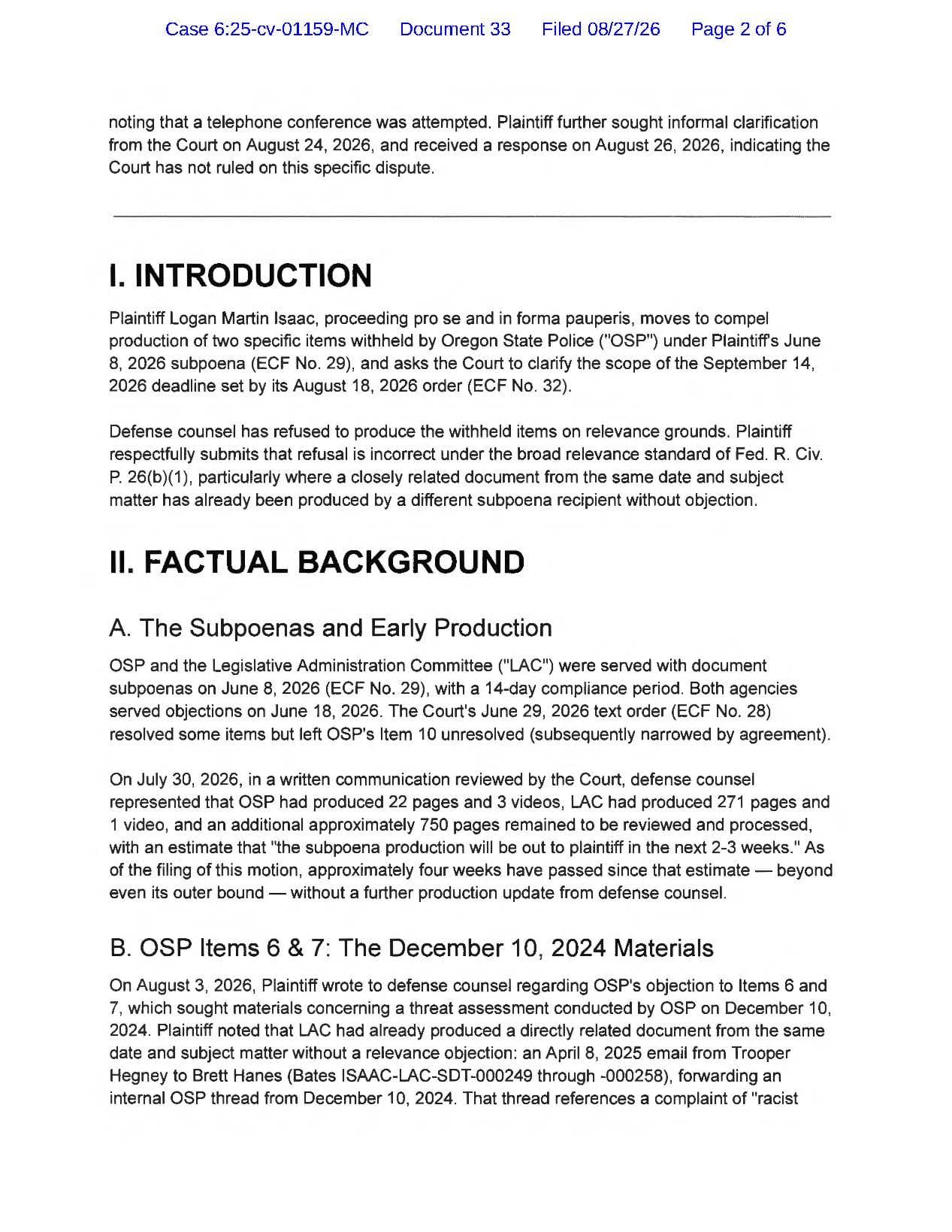
OSP and the Legislative Administration Committee ("LAC") were served with document subpoenas on June 8, 2026 (ECF No. 29), with a 14-day compliance period. Both agencies served objections on June 18, 2026. The Court's June 29, 2026 text order (ECF No. 28) resolved some items but left OSP's Item 10 unresolved (subsequently narrowed by agreement).
On July 30, 2026, in a written communication reviewed by the Court, defense counsel represented that OSP had produced 22 pages and 3 videos, LAC had produced 271 pages and 1 video, and an additional approximately 750 pages remained to be reviewed and processed, with an estimate that "the subpoena production will be out to plaintiff in the next 2-3 weeks." As of the filing of this motion, approximately four weeks have passed since that estimate — beyond even its outer bound — without a further production update from defense counsel.
B. OSP Items 6 & 7: The December 10, 2024 Materials
On August 3, 2026, Plaintiff wrote to defense counsel regarding OSP's objection to Items 6 and 7, which sought materials concerning a threat assessment conducted by OSP on December 10, 2024. Plaintiff noted that LAC had already produced a directly related document from the same date and subject matter without a relevance objection: an April 8, 2025 email from Trooper Hegney to Brett Hanes (Bates ISAAC-LAC-SDT-000249 through -000258), forwarding an internal OSP thread from December 10, 2024. That thread references a complaint of "racist remarks" involving ODVA Director Nakeia Daniels, and states that Trooper Anspaugh-Lubans performed a threat assessment in response, with a log entry summarizing the investigation and its conclusion.
Two items remain outstanding and are squarely within Items 6 and 7 as served:
- The complaint, report, or referral that initiated Trooper Anspaugh-Lubans' assessment; and
- The complete threat assessment itself, of which the log entry in the already-produced Hegney email appears to be only a summary.
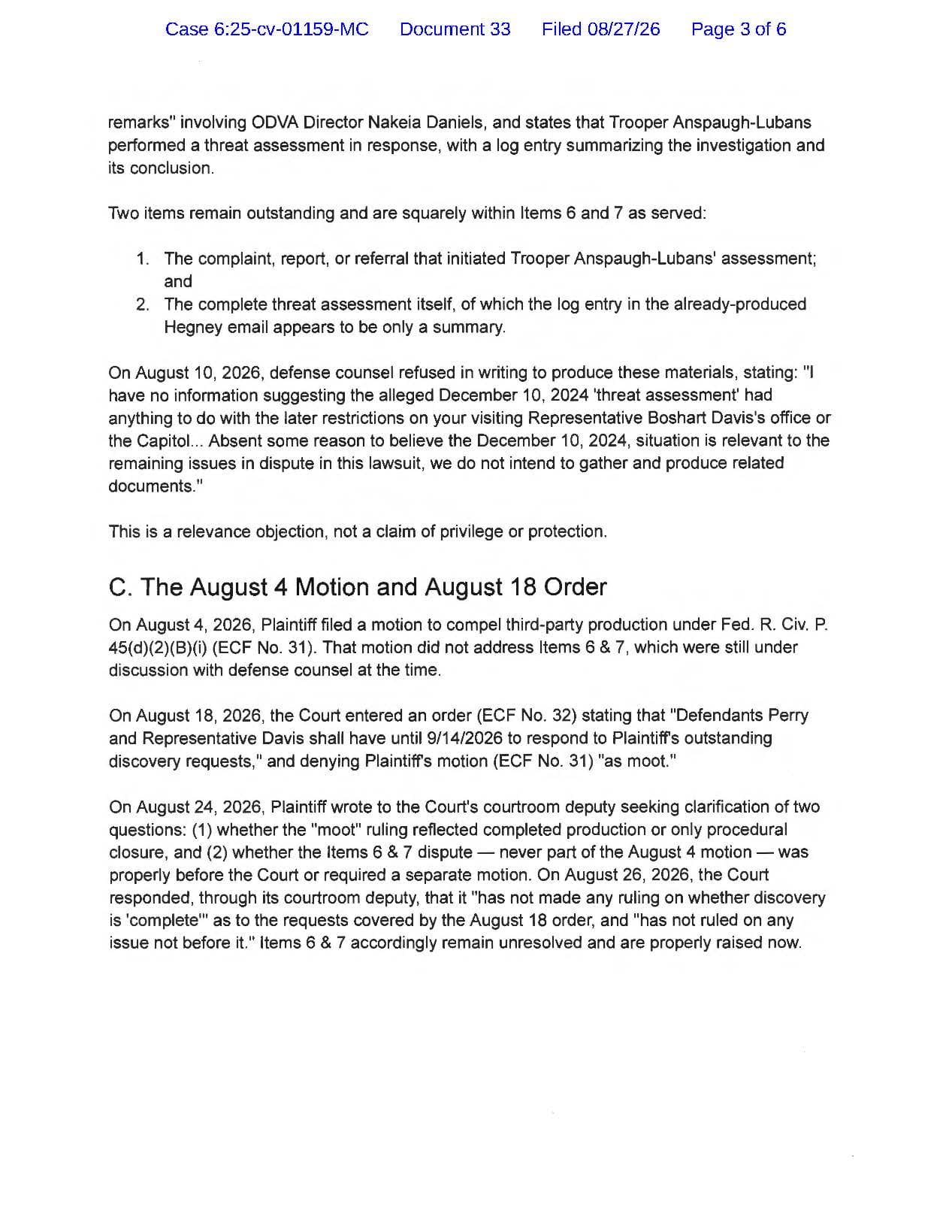
On August 10, 2026, defense counsel refused in writing to produce these materials, stating: "I have no information suggesting the alleged December 10, 2024 'threat assessment' had anything to do with the later restrictions on your visiting Representative Boshart Davis's office or the Capitol... Absent some reason to believe the December 10, 2024, situation is relevant to the remaining issues in dispute in this lawsuit, we do not intend to gather and produce related documents."
This is a relevance objection, not a claim of privilege or protection.
C. The August 4 Motion and August 18 Order
On August 4, 2026, Plaintiff filed a motion to compel third-party production under Fed. R. Civ. P. 45(d)(2)(B)(i) (ECF No. 31). That motion did not address Items 6 & 7, which were still under discussion with defense counsel at the time.
On August 18, 2026, the Court entered an order (ECF No. 32) stating that "Defendants Perry and Representative Davis shall have until 9/14/2026 to respond to Plaintiff's outstanding discovery requests," and denying Plaintiff's motion (ECF No. 31) "as moot."
On August 24, 2026, Plaintiff wrote to the Court's courtroom deputy seeking clarification of two questions: (1) whether the "moot" ruling reflected completed production or only procedural closure, and (2) whether the Items 6 & 7 dispute — never part of the August 4 motion — was properly before the Court or required a separate motion. On August 26, 2026, the Court responded, through its courtroom deputy, that it "has not made any ruling on whether discovery is 'complete'" as to the requests covered by the August 18 order, and "has not ruled on any issue not before it." Items 6 & 7 accordingly remain unresolved and are properly raised now.
III. LEGAL STANDARD
A. Scope of Discovery
Fed. R. Civ. P. 26(b)(1) provides that parties "may obtain discovery regarding any nonprivileged matter that is relevant to any party's claim or defense and proportional to the needs of the case, considering the importance of the issues at stake in the action, the amount in controversy, the parties' relative access to relevant information, the parties' resources, the importance of the discovery in resolving the issues, and whether the burden or expense of the proposed discovery outweighs its likely benefit." The rule further provides that "[i]nformation within this scope of discovery need not be admissible in evidence to be discoverable."
B. Motion to Compel Third-Party Production
Fed. R. Civ. P. 45(d)(2)(B) provides that where a subpoenaed person serves a written objection, "the serving party may move the court for the district where compliance is required for an order compelling production or inspection" at any time, on notice to the commanded person. Fed. R. Civ. P. 45(d)(2)(B)(i).
C. Rule 1
Fed. R. Civ. P. 1 provides that the rules "should be construed, administered, and employed by the court and the parties to secure the just, speedy, and inexpensive determination of every action and proceeding."
IV. ARGUMENT
A. The December 10, 2024 Materials Are Relevant Under Rule 26(b)(1)
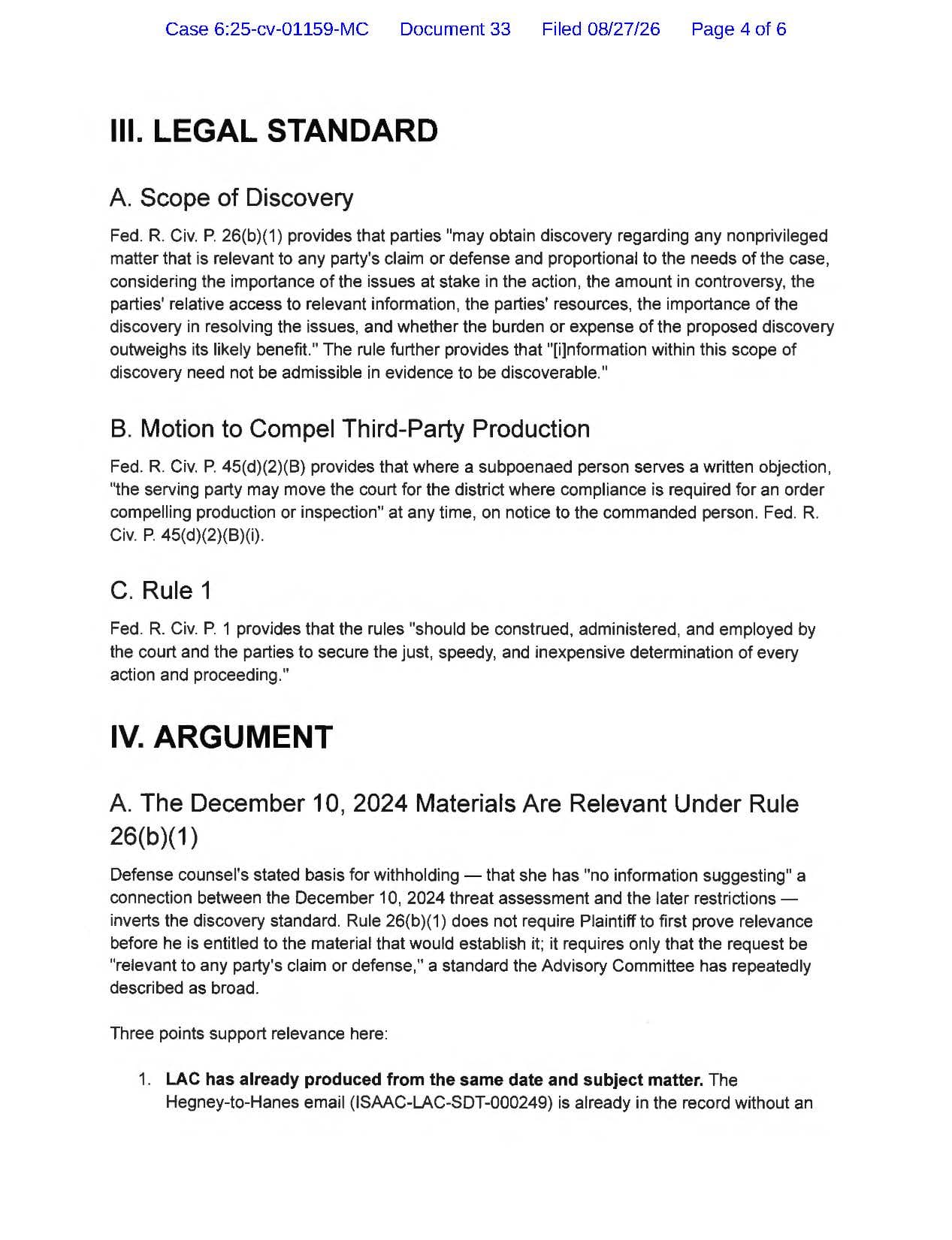
Defense counsel's stated basis for withholding — that she has "no information suggesting" a connection between the December 10, 2024 threat assessment and the later restrictions — inverts the discovery standard. Rule 26(b)(1) does not require Plaintiff to first prove relevance before he is entitled to the material that would establish it; it requires only that the request be "relevant to any party's claim or defense," a standard the Advisory Committee has repeatedly described as broad.
Three points support relevance here:
- LAC has already produced from the same date and subject matter. The Hegney-to-Hanes email (ISAAC-LAC-SDT-000249) is already in the record without an LAC relevance objection. It documents that OSP conducted and concluded a threat assessment concerning Plaintiff seven weeks before the Capitol access restrictions at issue in this case were first imposed. A party cannot maintain that the broader investigative file behind an already-produced, undisputed document is categorically irrelevant to the same case.
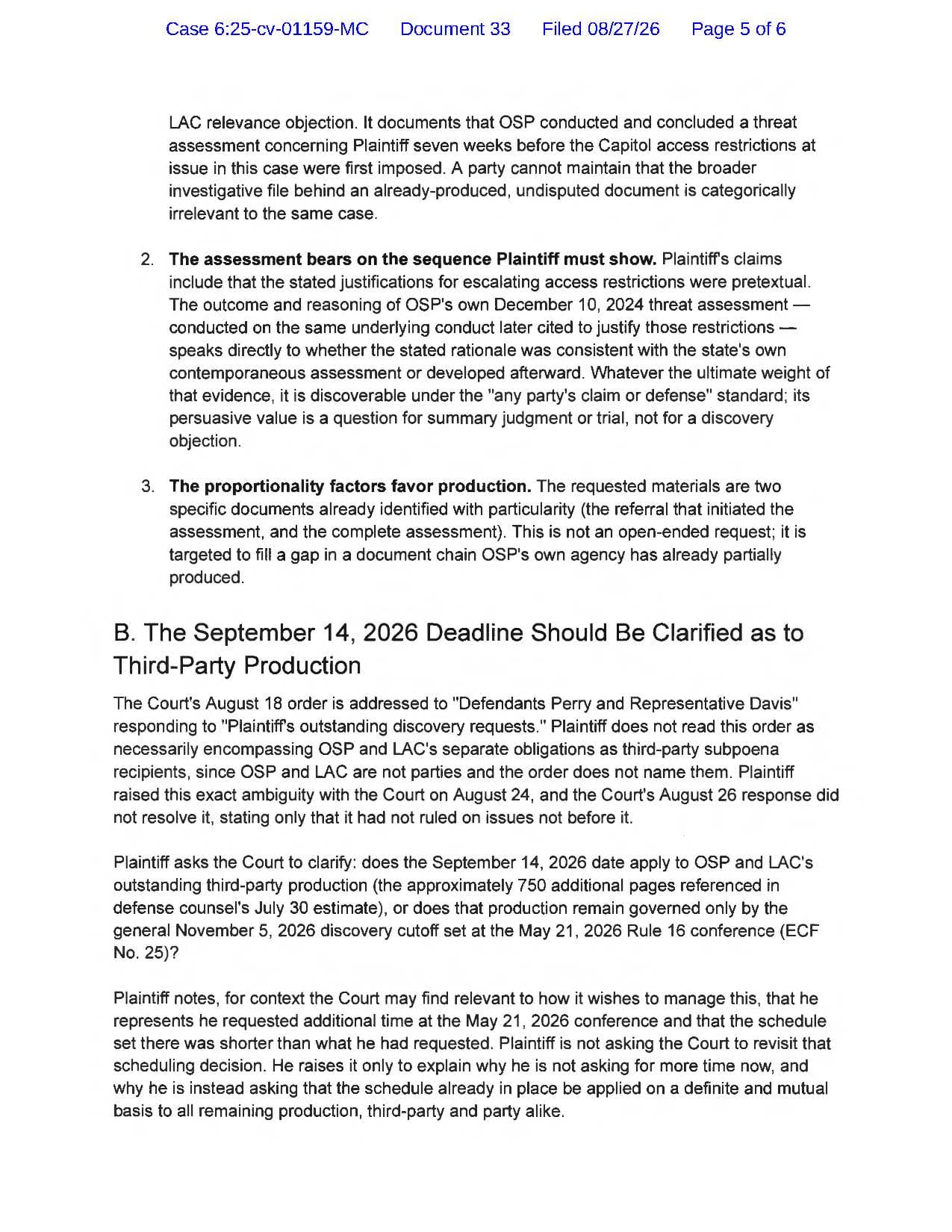
- The assessment bears on the sequence Plaintiff must show. Plaintiff's claims include that the stated justifications for escalating access restrictions were pretextual. The outcome and reasoning of OSP's own December 10, 2024 threat assessment — conducted on the same underlying conduct later cited to justify those restrictions — speaks directly to whether the stated rationale was consistent with the state's own contemporaneous assessment or developed afterward. Whatever the ultimate weight of that evidence, it is discoverable under the "any party's claim or defense" standard; its persuasive value is a question for summary judgment or trial, not for a discovery objection.
- The proportionality factors favor production. The requested materials are two specific documents already identified with particularity (the referral that initiated the assessment, and the complete assessment). This is not an open-ended request; it is targeted to fill a gap in a document chain OSP's own agency has already partially produced.
B. The September 14, 2026 Deadline Should Be Clarified as to Third-Party Production
The Court's August 18 order is addressed to "Defendants Perry and Representative Davis" responding to "Plaintiff's outstanding discovery requests." Plaintiff does not read this order as necessarily encompassing OSP and LAC's separate obligations as third-party subpoena recipients, since OSP and LAC are not parties and the order does not name them. Plaintiff raised this exact ambiguity with the Court on August 24, and the Court's August 26 response did not resolve it, stating only that it had not ruled on issues not before it.
Plaintiff asks the Court to clarify: does the September 14, 2026 date apply to OSP and LAC's outstanding third-party production (the approximately 750 additional pages referenced in defense counsel's July 30 estimate), or does that production remain governed only by the general November 5, 2026 discovery cutoff set at the May 21, 2026 Rule 16 conference (ECF No. 25)?
Plaintiff notes, for context the Court may find relevant to how it wishes to manage this, that he represents he requested additional time at the May 21, 2026 conference and that the schedule set there was shorter than what he had requested. Plaintiff is not asking the Court to revisit that scheduling decision. He raises it only to explain why he is not asking for more time now, and why he is instead asking that the schedule already in place be applied on a definite and mutual basis to all remaining production, third-party and party alike.
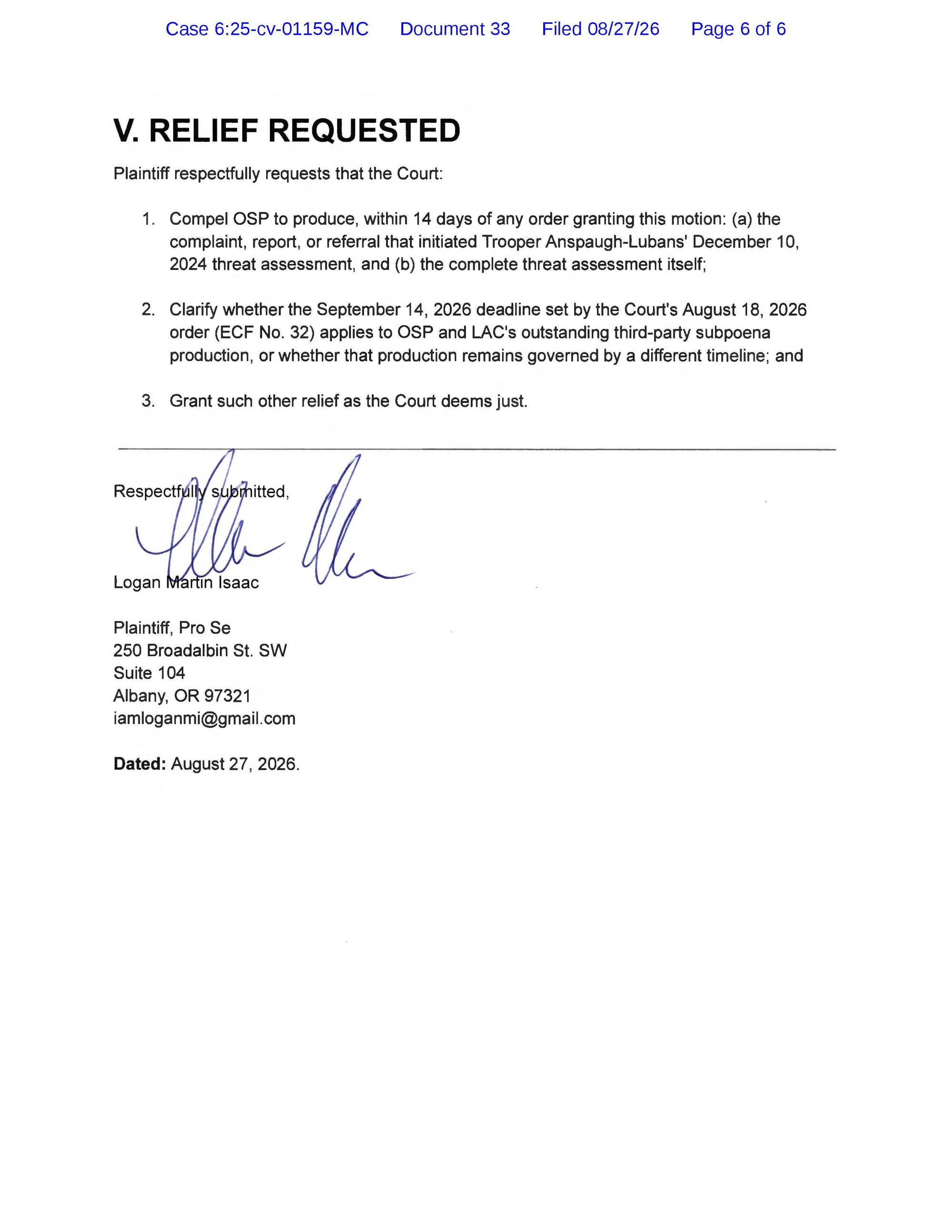
V. RELIEF REQUESTED
Plaintiff respectfully requests that the Court:
- Compel OSP to produce, within 14 days of any order granting this motion: (a) the complaint, report, or referral that initiated Trooper Anspaugh-Lubans' December 10, 2024 threat assessment, and (b) the complete threat assessment itself;
- Clarify whether the September 14, 2026 deadline set by the Court's August 18, 2026 order (ECF No. 32) applies to OSP and LAC's outstanding third-party subpoena production, or whether that production remains governed by a different timeline; and
- Grant such other relief as the Court deems just.
Images