State Defendant's Response to Motion to Compel (ECF 34)

Isaac v. Manning et al., No. 6:25-cv-01159-MC (D. Or.) is a federal civil-rights lawsuit against James Ivory Manning Jr., Shelly Boshart Davis, Renee Perry, and Doe defendants, filed in the U.S. District Court for the District of Oregon on July 3, 2025.
Docket Text: Response State Defendants' Response to Plaintiff's Motion to Compel to Motion to CompelMotion for Clarification Order on Motion to Compel, 32 33 . Filed by Shelly Boshart Davis, Renee Perry. (White, Tracy) (Entered: 09/10/2026)
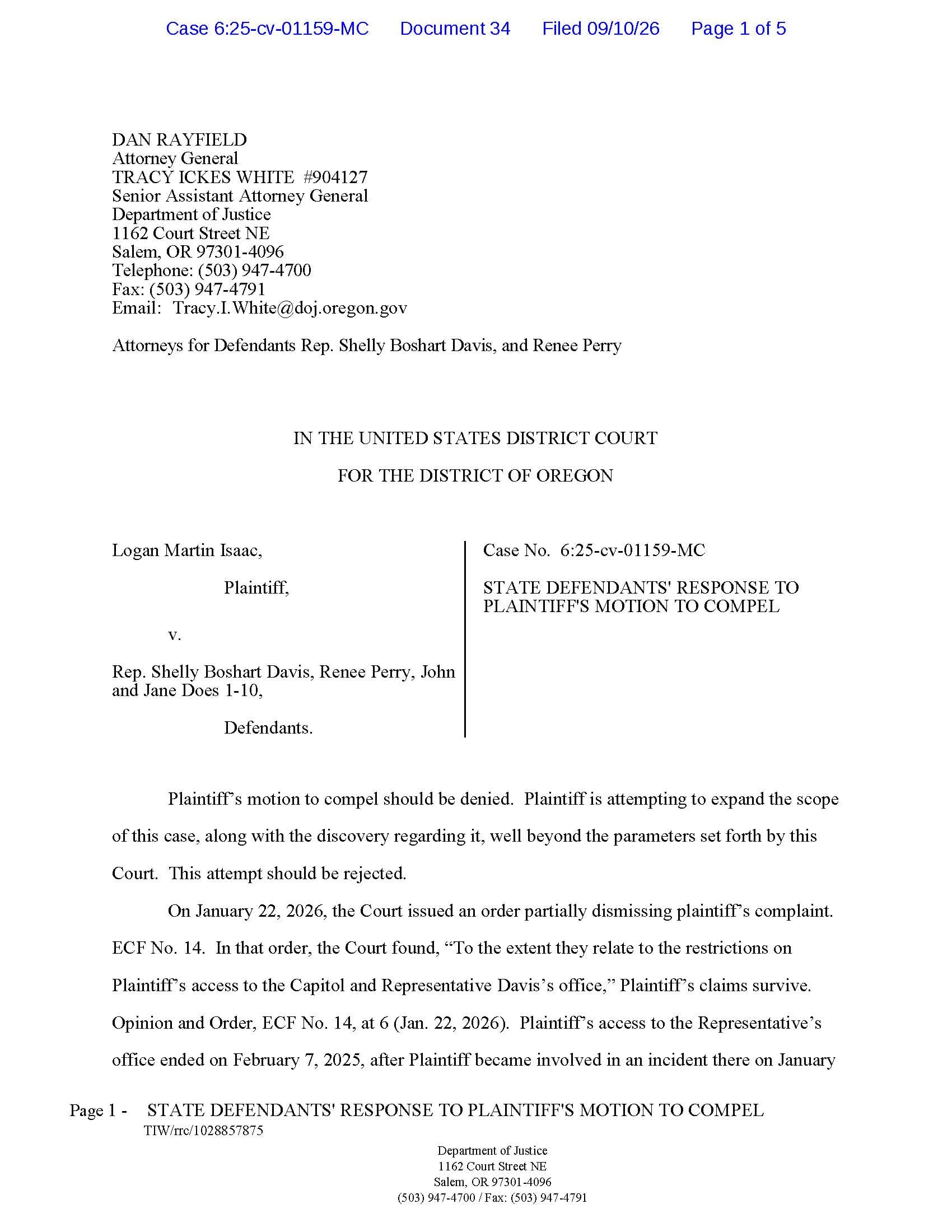
STATE DEFENDANTS' RESPONSE TO PLAINTIFF'S MOTION TO COMPEL
Plaintiff’s motion to compel should be denied. Plaintiff is attempting to expand the scope of this case, along with the discovery regarding it, well beyond the parameters set forth by this Court. This attempt should be rejected.
On January 22, 2026, the Court issued an order partially dismissing plaintiff’s complaint. ECF No. 14. In that order, the Court found, “To the extent they relate to the restrictions on Plaintiff’s access to the Capitol and Representative Davis’s office,” Plaintiff’s claims survive. Opinion and Order, ECF No. 14, at 6 (Jan. 22, 2026). Plaintiff’s access to the Representative’s office ended on February 7, 2025, after Plaintiff became involved in an incident there on January 27, 2025. Id. at 2. Plaintiff’s access to the Capitol was restricted on February 21, 2025. Id. at 2-3. These restrictions are the only bases for the claims in this action. Id. at 6-7.
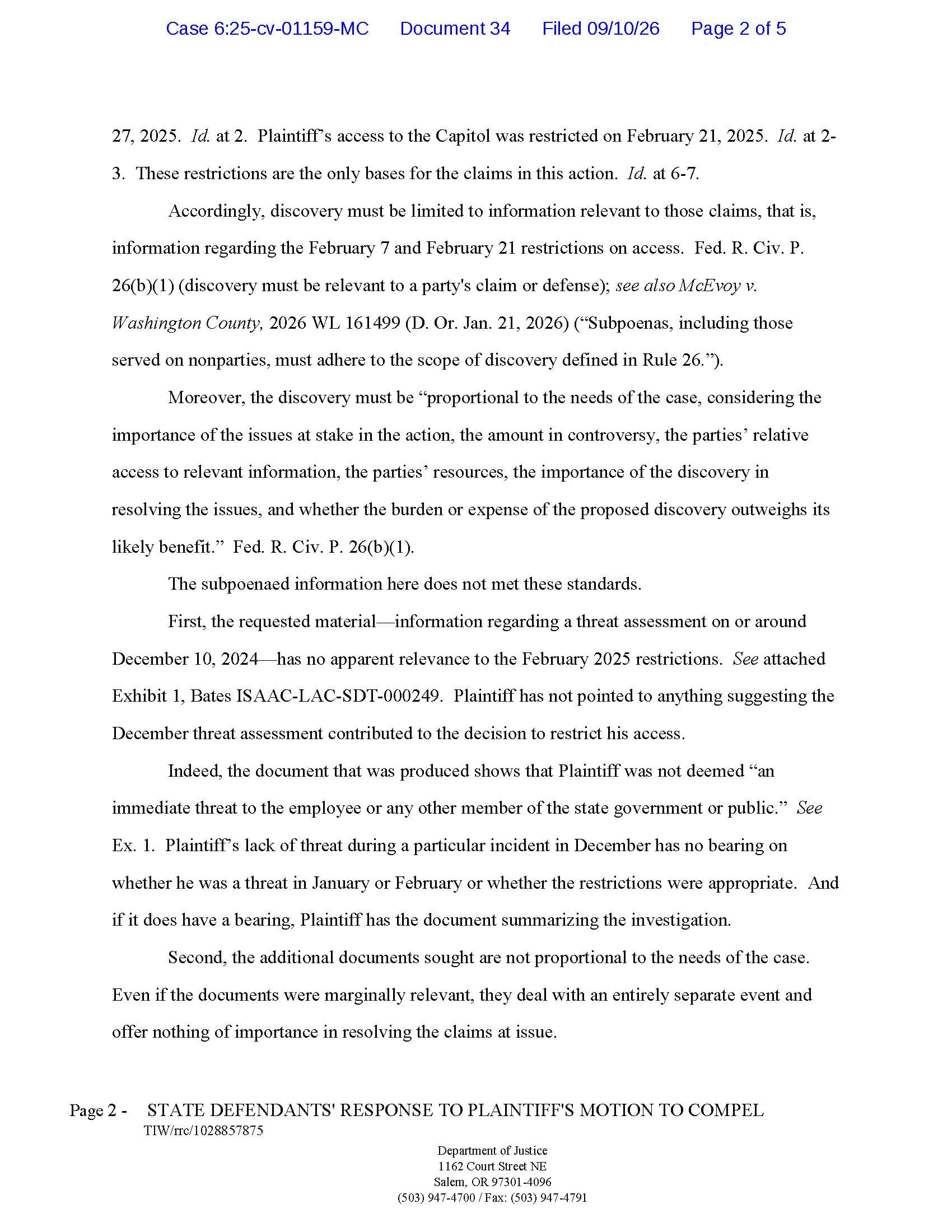
Accordingly, discovery must be limited to information relevant to those claims, that is, information regarding the February 7 and February 21 restrictions on access. Fed. R. Civ. P. 26(b)(1) (discovery must be relevant to a party's claim or defense); see also McEvoy v. Washington County, 2026 WL 161499 (D. Or. Jan. 21, 2026) (“Subpoenas, including those served on nonparties, must adhere to the scope of discovery defined in Rule 26.”).
Moreover, the discovery must be “proportional to the needs of the case, considering the importance of the issues at stake in the action, the amount in controversy, the parties’ relative access to relevant information, the parties’ resources, the importance of the discovery in resolving the issues, and whether the burden or expense of the proposed discovery outweighs its likely benefit.” Fed. R. Civ. P. 26(b)(1).
The subpoenaed information here does not met these standards.
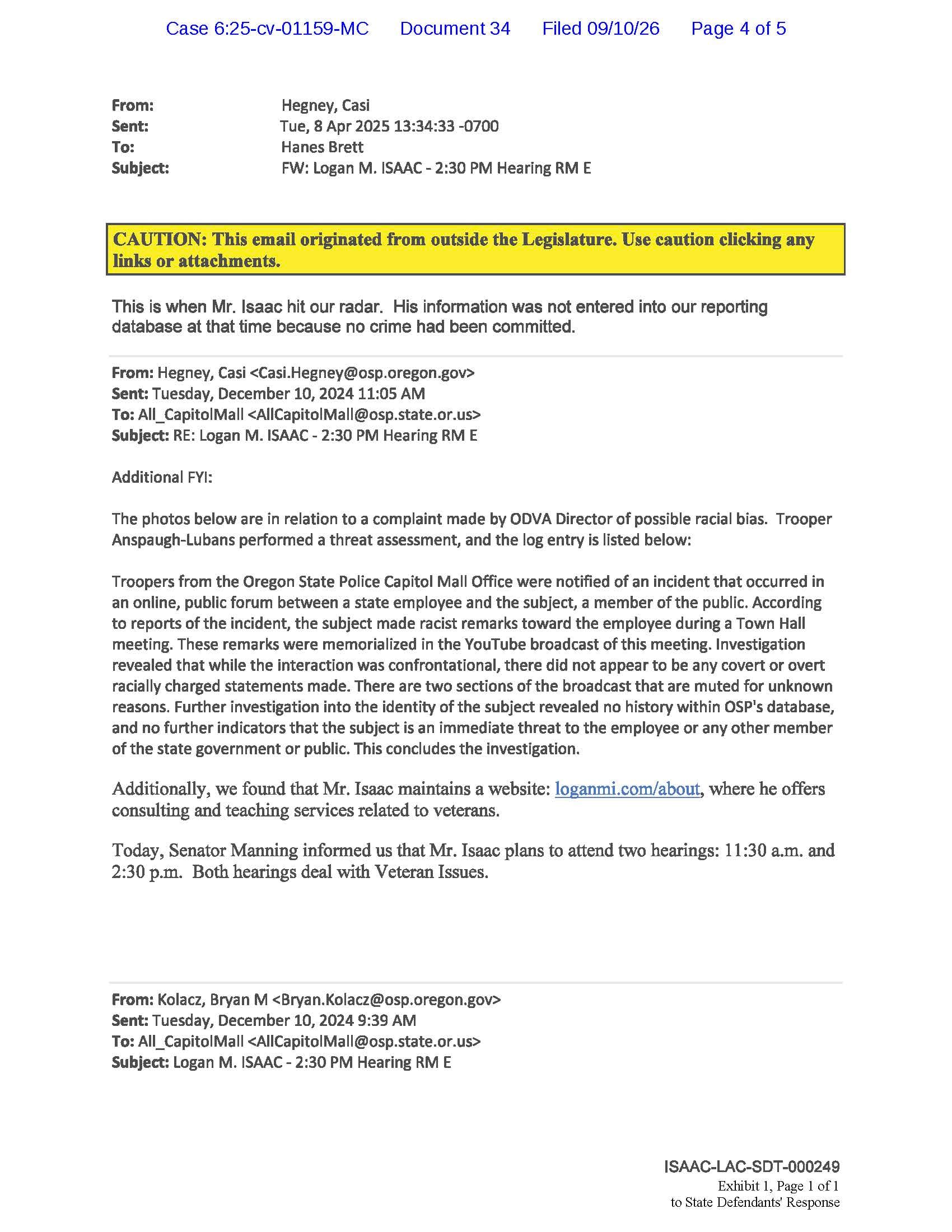
First, the requested material—information regarding a threat assessment on or around December 10, 2024—has no apparent relevance to the February 2025 restrictions. See attached Exhibit 1, Bates ISAAC-LAC-SDT-000249. Plaintiff has not pointed to anything suggesting the December threat assessment contributed to the decision to restrict his access.
Indeed, the document that was produced shows that Plaintiff was not deemed “an immediate threat to the employee or any other member of the state government or public.” See Ex. 1. Plaintiff’s lack of threat during a particular incident in December has no bearing on whether he was a threat in January or February or whether the restrictions were appropriate. And if it does have a bearing, Plaintiff has the document summarizing the investigation.
Second, the additional documents sought are not proportional to the needs of the case. Even if the documents were marginally relevant, they deal with an entirely separate event and offer nothing of importance in resolving the claims at issue.
Third, the fact that the December 10, 2024 email was produced is not an admission of relevance or otherwise a waiver of anything. That email was simply part of a later April 8, 2025 email to Brett Hanes regarding Plaintiff.
For these reasons, the motion to compel should be denied.
Separately, Plaintiff’s request for clarification of the Court’s prior order should be rejected. The Order speaks for itself.