📧 “On Solidarity and Exhaustion”
Hey Esau,
I've been trying to get the Church to hear veteran theological voices for over a decade. I'm exhausted. I don't have another ten years in me to keep knocking on doors that won't open, to keep making the case that military families deserve the same recognition as other marginalized communities.
When my family supported yours in Scotland - Laura watching your kids, showing up at your vigil for Mike Brown - that wasn't transactional. That was what we do for each other when we're both far from home, both navigating communities that don't always see us. I thought that meant something.
When I reached out as a fellow military family asking for solidarity, I wasn't asking for much. I was asking you to see what I know you can see: that the exclusion I'm documenting is real, that it matters, and that your voice acknowledging it would mean something to the military families who feel invisible in Christian spaces.
I know you read my work. You saw me draw the parallel between what ERB did to my book and what they'd never do to yours. And you were silent.
I can't make you respond. I can't make you care. But I won't pretend silence is neutral, either. This is where our faith either matters or it doesn't - not in the safety of book endorsements and conference talks, but in the hard places where standing with someone costs something.
I'm not going to keep fighting this. I'm going to document what happened. Not because I want to hurt you, but because the veterans coming after me deserve to know what they're walking into. They deserve to know that when Christian influencers talk a good game about marginalization but go silent when it's military suicide. They deserve to know that even fellow military families sometimes choose comfort over solidarity.
I've given you years and multiple private appeals. I followed Matthew 18. If I have to, I'll make our correspondence public as well, because the pattern matters more than any individual relationship. If you want to respond, I'll listen. If you don't, that's an answer too. As I told your Wheaton colleague, George Kalantzis, "I worship a public god." You don't have to, freedom of worship is a right I'll still die for, but I do.
I'm too tired for hope, given our history, but I'm done pretending silence is acceptable. This is the dumpster fire behind the Reichstag. Either our faith means something here, or it never meant much at all.
20250113 @ 0611
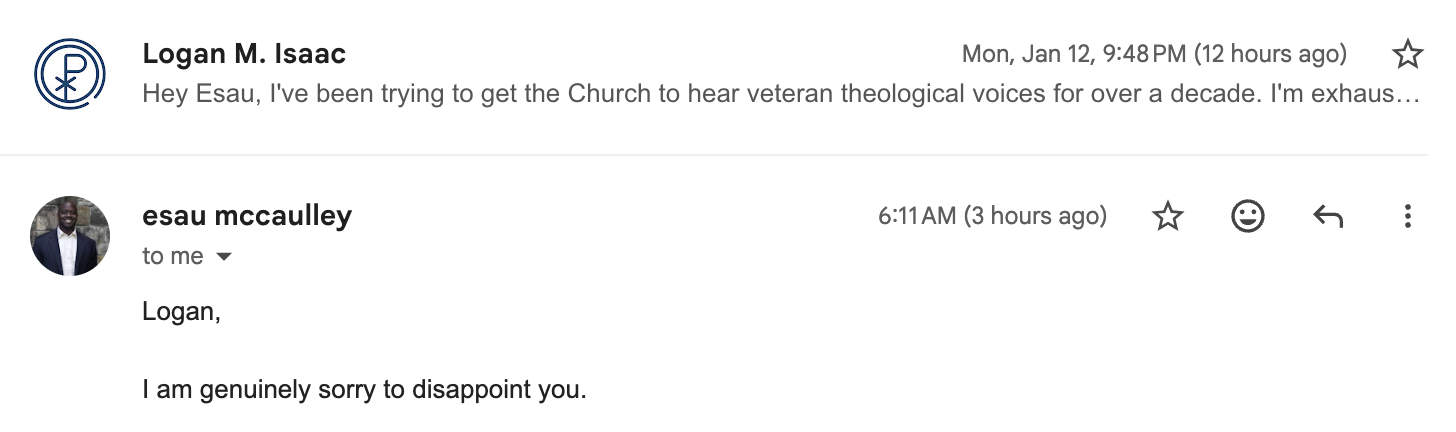
Logan,
I am genuinely sorry to disappoint you.
I do wish you the best in your ministry to military members and their families.
You may not care or be moved by this, but the list of things that I am commanded to speak about or do or else I do not care or am complicit is endless.
I am a pastor, husband, father, professor, writer, columnist, and podcaster with some limits on my time and ability.
People on the other sides of those decisions may take it as animus or lack or concern. It is not.
It is simply a boundary. I have learned to extend grace to myself and accept my limits.
My decision on which matters to engage is not taken lightly or without reflection.
I think it is best for us at this point to discontinue correspondence.
Blessings on your ministry (I mean that),
Esau McCaulley, Ph.D.
The Jonathan Blanchard Associate Professor of New Testament and Public Theology, Wheaton College
Author of How Far to the Promised Land: One Black Family’s Story of Hope and Survival in the American South