📧 “Comment Opportunity” to NYTimes
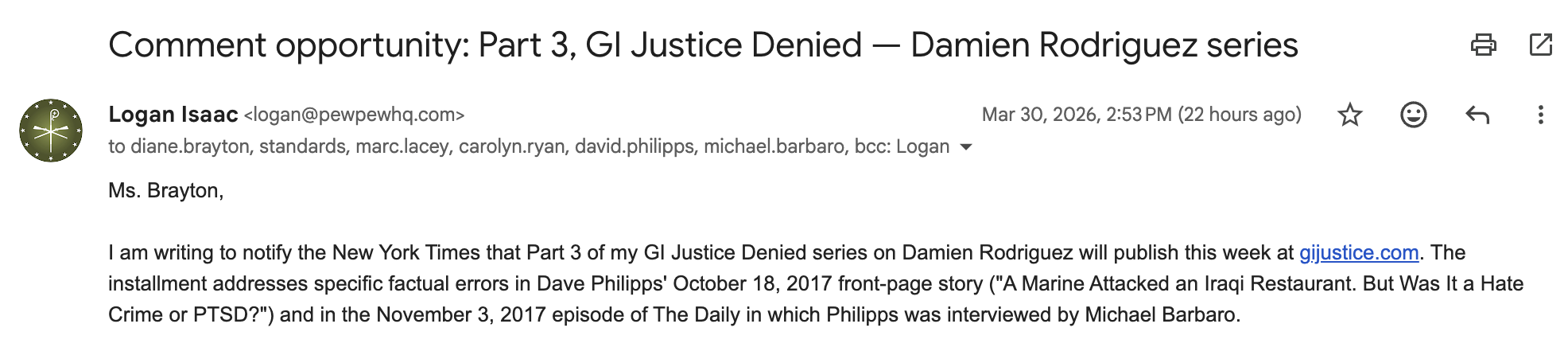
I am writing to notify the New York Times that Part 3 of my GI Justice Denied series on Damien Rodriguez will publish this week at GIJustice.com. The installment addresses specific factual errors in Dave Philipps' October 18, 2017 front-page story ("A Marine Attacked an Iraqi Restaurant. But Was It a Hate Crime or PTSD?") and in the November 3, 2017 episode of The Daily in which Philipps was interviewed by Michael Barbaro.
The central documented error: no law in the Oregon Revised Statutes has ever been designated a "hate crime." ORS 166.155, Intimidation II, was a misdemeanor bias charge in 2017, not amended to "Bias Crime" until 2019. No federal hate crimes charges were ever filed. The legal premise on which both the article and the episode were framed did not exist in Oregon law.
The piece includes the following passage, which I offer here so that you are not without notice of the argument being made:
"What happened to Damien Rodriguez is a case study in what Section 4712 was written to address: a protected member of the military community, subjected to a media and prosecutorial environment shaped by institutional indifference to his actual legal status, denied the specialized court designed for his precise situation, and never once afforded the protection the law specifically extended to him. Instead, HCPA's language was borrowed — misnamed, misapplied, stripped of its context — and used to build the narrative that destroyed his career and his access to treatment."
Section 4712 of the Matthew Shepard and James Byrd Jr. Hate Crimes Prevention Act of 2009 extended federal hate crime protections explicitly to members of the uniformed services and their families. It is part of the same statute your reporting cited. It was never engaged in any coverage of this case by the Times or any other outlet.
I also possess a full transcript of the November 3, 2017 Daily episode, preserved as documentary evidence in connection with pending civil rights litigation. Specific quotations from that transcript are addressed in Part 3.
If the New York Times wishes to issue a correction, respond to the factual record, or provide comment for inclusion before publication, I am available through the end of business Friday, April 4, 2025.
Silence will be noted in the published piece as it has been in prior correspondence.