Damien Rodriguez (pt. 2): "It's Obvious"
TL;DR — After a Portland Police Bureau (PPB) spokesperson mischaracterized Oregon law and The Oregonian published a false headline, a restaurant co-owner repeated the "hate crime" label on camera. She was not among the legal victims. She was, however, a witness before the Grand Jury that escalated Damien Rodriguez's charges from misdemeanors to a felony — the charge that barred him from the one court designed to help veterans like him.
In Part 1 of this series, I established that no law in the Oregon Revised Statutes has ever been called a "hate crime," that Lizzy Acker of The Oregonian published a headline using that phrase anyway, and that PPB Public Information Officer SGT Pete Simpson was cited as the source of the characterization. What I couldn't pin down — and still can't, definitively — is who said it first.
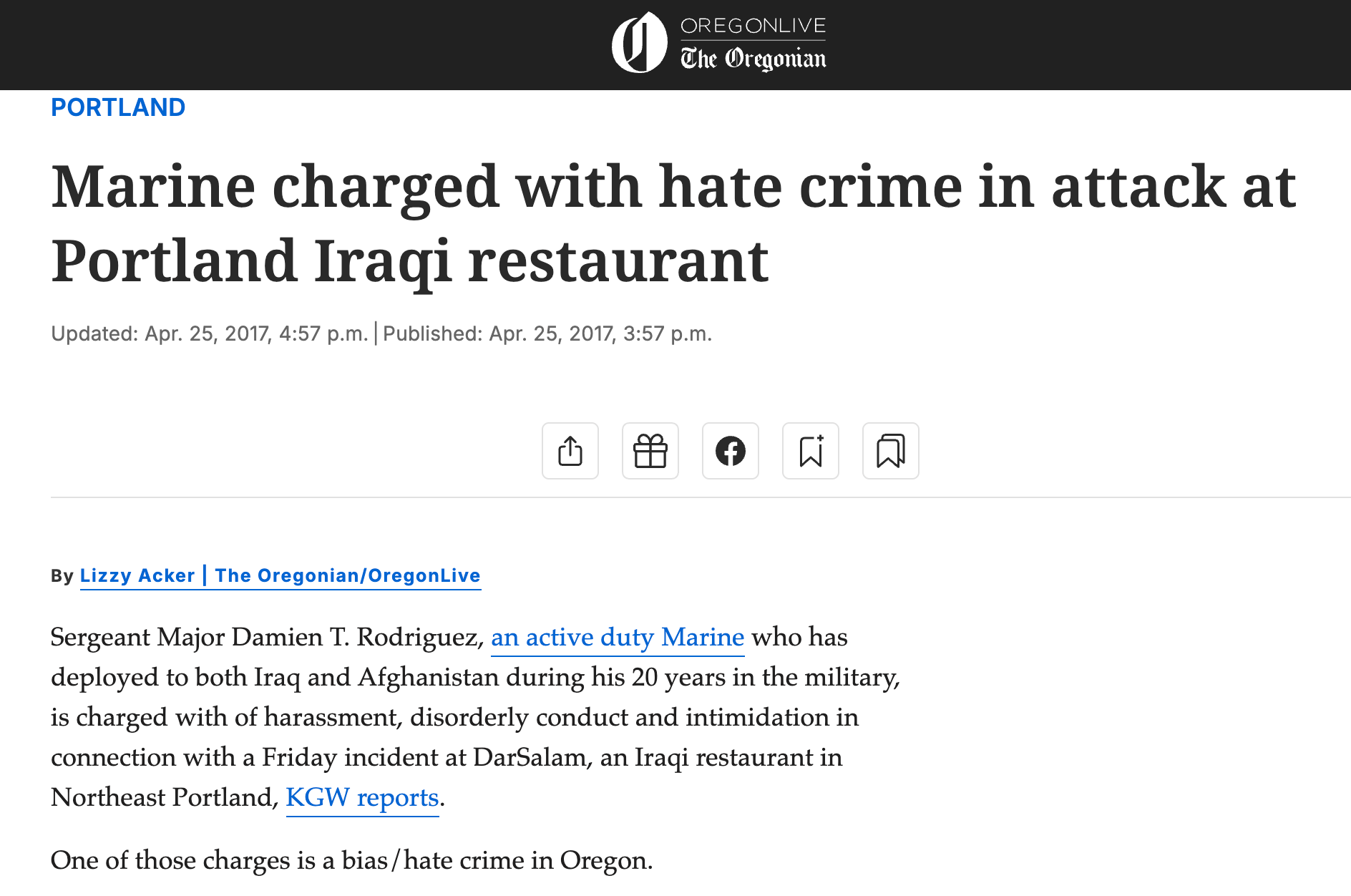
Screenshot of Lizzy Acker’s 2017 article on Damien Rodriguez
The Oregonian's story was archived by the Wayback Machine on April 25, 2017, indicating it was live before 2:00 PM that day. KATU's segment — which included footage from what appears to have been a press conference outside DarSalam — didn't air until 6:18 PM. So either SGT Simpson used "hate crime" language independently when he briefed Lizzy Acker that morning, or the press conference happened before 2:00 PM and Acker had already been there or been briefed on it. Either way, the record is clear that Simpson told Acker ORS 166.155 was "a bias/hate crime law in Oregon." It is not, and he is a professional law enforcement officer who is obligated to know the difference.
What happened next matters.
"It's Obvious"
KATU's Bob Heye covered the same presser without using the word "hate." His report was careful. DarSalam co-owner Tiffany Sahib, speaking to Heye on camera, said: "Clearly these people had a problem with Middle Easterners or Iraq. And they came in looking for trouble or looking to express their anger."
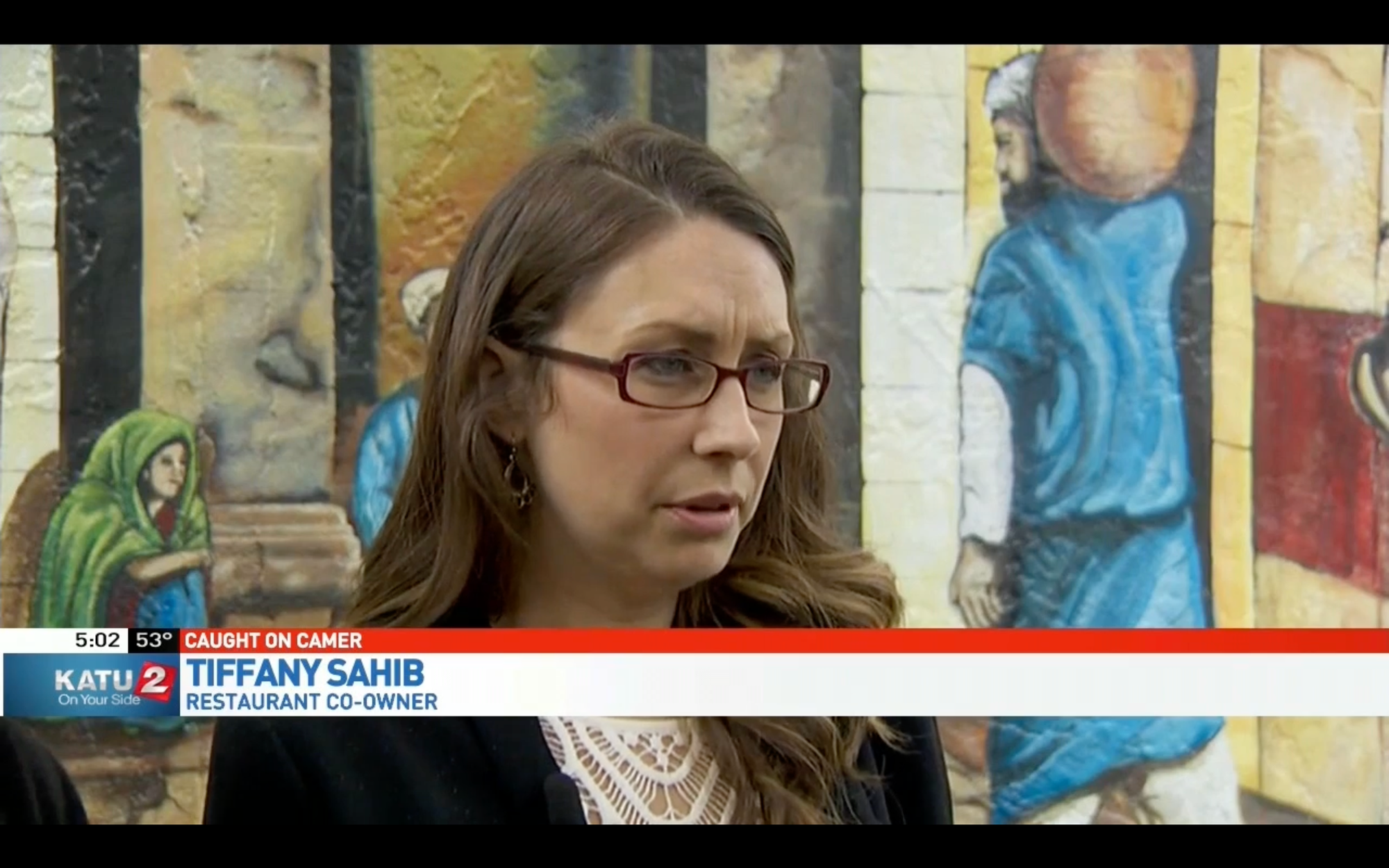
Tiffany Sahib, former co-owner of Dar Salaam restaurants in Portland, OR. Click for source.
That's an emotional response from a business owner whose employee had just been hurt. Whatever you think of its accuracy, it's the kind of thing a person says in the immediate aftermath of a violent incident on their premises. It is not a legal characterization.
KGW's Pat Dorris, in a separate segment that appears to use footage from the same press conference, got something different. Dorris apparently suggested a reason for the attack — that Rodriguez had spent time in Iraq — to which Tiffany responded, on camera: "No, haha, no. It's obvious it's a hate crime. And it was an assault. Our staff member is injured physically, both of our staff members that were most directly involved are traumatized emotionally as well."
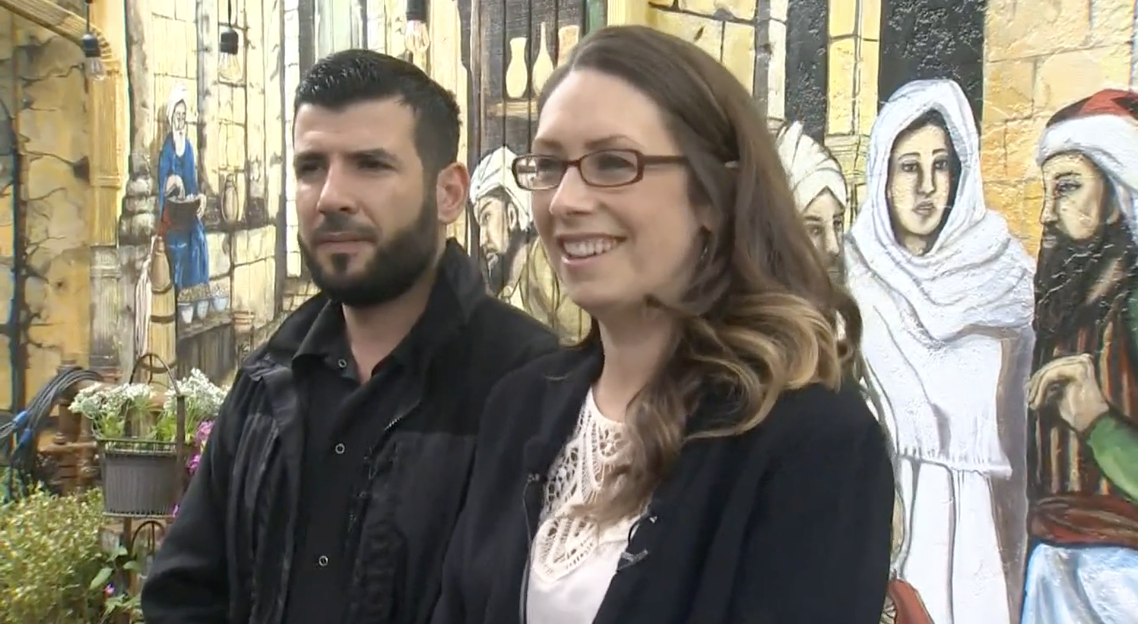
"It's obvious it's a hate crime." - Tiffany Sahib. Click for KGW8 source.
Two things to note. First, Tiffany Sahib is not a lawyer, a law enforcement officer, or a public official. She has no obligation to know the difference between a federal statute and a state misdemeanor charge. Her emotional reaction is entirely human.
Second — and this is the part that matters — she is also not listed among the legal victims of the incident.
The court records are specific. The compensatory fines ordered at sentencing went to two people: Badran Hamood, the employee struck by the chair ($11,000), and Shaymaa Alquriqchee, the employee subjected to offensive physical contact ($10,000). Tiffany Sahib received nothing in the judgment, because she was not a named victim. She was a witness — and a vocal one.
That distinction becomes significant in what comes next.
The Question Dorris Answered for Himself
KGW's reporter told Portlanders that Rodriguez targeted DarSalam "because... [he] spent time in Iraq." That is not reporting. That is a reporter providing the motive of a crime that hadn't yet been adjudicated, based on nothing more than the existence of a connection between the suspect and the country in question.
It also happens to be logically backward. Rodriguez had spent years fighting for the Iraqi people, not against them. But Dorris' editorial leap — soldier + Iraq experience = anti-Iraqi hate — became part of the media atmosphere surrounding the case. No one corrected it on air. Or since.
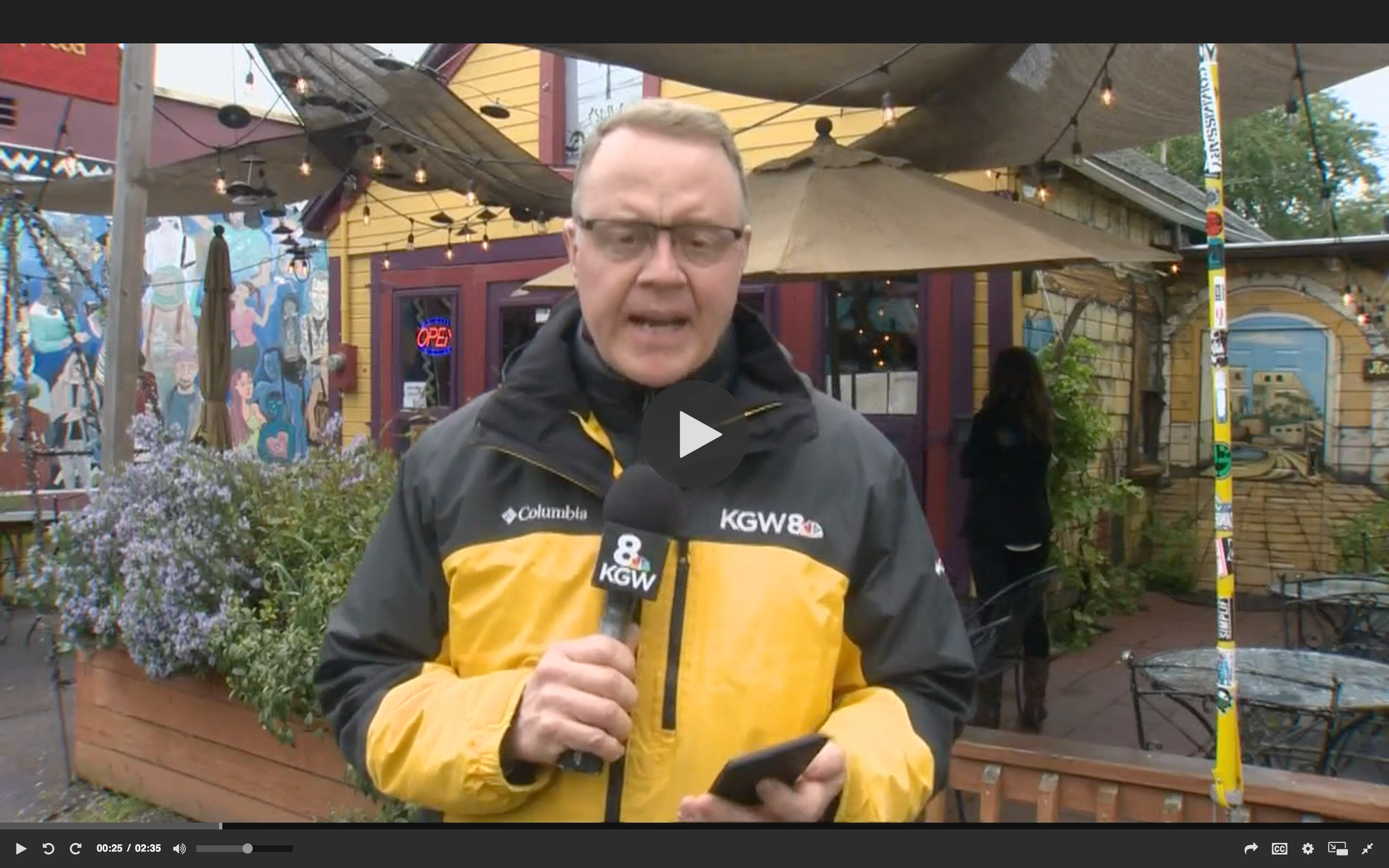
Pat Dooris suggesting, on broadcast television, that combat service causes hate crimes.
From Microphone to Grand Jury
Here is the sequence the record supports.
On April 24, 2017, a Multnomah County District Attorney filed an Information charging Rodriguez with Harassment (Class B Misdemeanor) and Disorderly Conduct in the Second Degree. Those are the charges the facts of the incident supported.
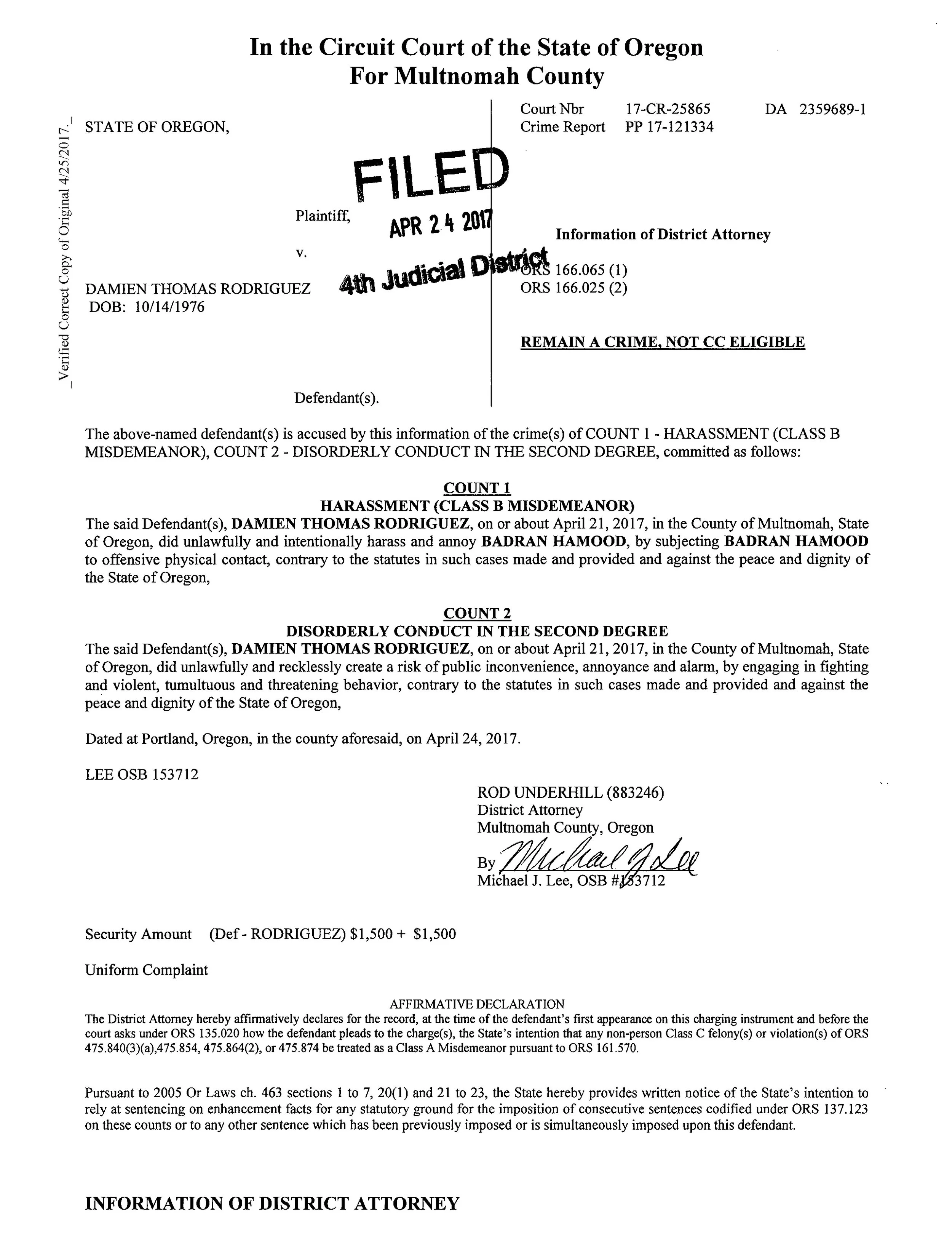
The following day, The Oregonian ran its false headline claiming Rodriguez had been charged with a "hate crime." That same day, Tiffany Sahib told KGW it was "obvious" a hate crime had been committed.
On April 26 — two days later — a judge signed a Judgment of Dismissal on the Information. The stated reason: "an investigation is pending, and the ends of justice will be best served by the dismissal." Translation: the DA was sending the case to a Grand Jury. On July 3, 2017, that Grand Jury returned a felony indictment.
The list of witnesses examined before the Grand Jury in person includes: Tiffany Sahib.
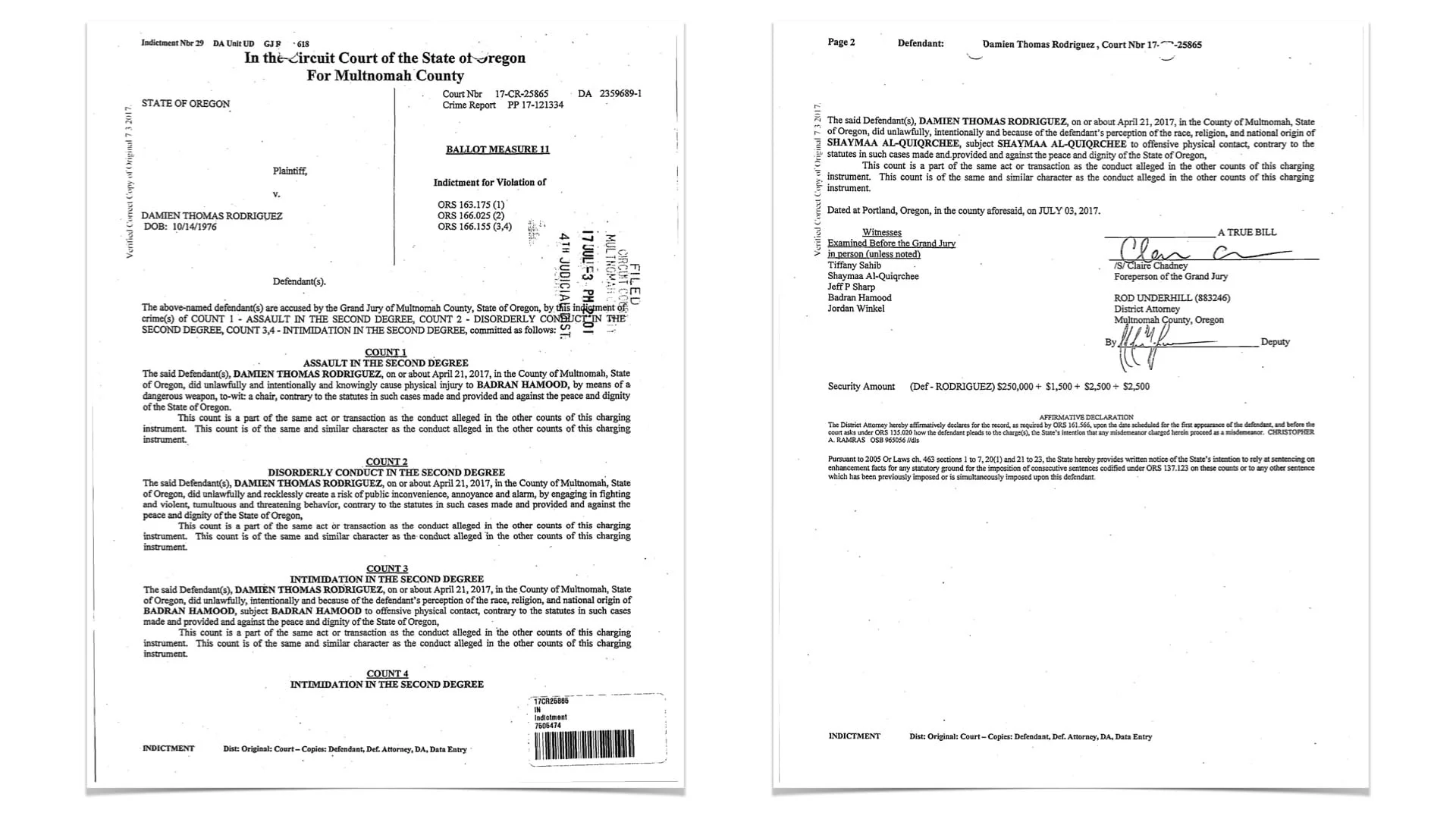
Tiffany Sahib appears on page two as a witness.
The Grand Jury charged Rodriguez with Assault in the Second Degree — a felony — along with Disorderly Conduct II and two counts of Intimidation II. The security amount jumped from $5,500 at booking to $257,500 after indictment. That is a forty-seven-fold increase.
I want to be precise about what this does and does not prove. Grand Jury proceedings are sealed. I don't know what Tiffany said under oath. What I know is that a woman who had publicly characterized the incident as an obvious hate crime — on camera, twice, to two different television outlets — was called as a witness in the proceedings that escalated Damien Rodriguez's charges from misdemeanors to a felony.
Why That Felony Mattered
Portland, like more than 350 cities across the country, has a veterans trauma court — a specialized docket designed to divert veterans with PTSD and substance abuse issues into supervised treatment rather than prison. The research behind these courts is straightforward: manage the trauma, and the behavior that flows from it tends to resolve.
Damien Rodriguez, a decorated Marine Corps Sergeant Major with four combat deployments, a documented PTSD diagnosis, no prior criminal history, and a substance abuse problem he was already trying to address, was exactly the population veterans courts were built for.
When charged with a violent felony, Damien Rodriguez was barred from accessing Portland's veterans court.
That felony was Assault in the Second Degree, from the July 3 Grand Jury indictment. The misdemeanor "hate crime" charge — ORS 166.155, Intimidation II — would not have barred him on its own. It was the escalation, not the bias charge, that closed the door. The escalation that came after 1) a police spokesperson called the wrong law by the wrong name, 2) a newspaper published a inaccurate headline, 3) a broadcast television reporter explicitly cited that false narrative, and 4) a non-victim witness told two local audiences that it was "obviously a hate crime."
Whether any of that caused the Grand Jury's decision is not something I can prove. The sequence is what it is.
The Restaurant That Loved Veterans
Here is something that didn't make the early coverage.
DarSalam was not a random target. It wasn't selected because it was Iraqi. By the time of the incident, it had become — to the surprise of its owners — a regular hangout for Iraq veterans. They held a poetry reading there. They became friends with the family.
Ghaith Sahib, the Iraqi-born co-owner who had survived a car bomb in Baghdad, fled through Syria, India, France, Germany, and the Netherlands before settling in Portland with his American wife, described what those relationships meant to him: "Always I have joy talking with them. They lost friends, we lost friends also. They cry, we cry also. We talk about it."
He opened DarSalam specifically to present a kinder face of Iraq to America. His regulars included the very people he was trying to reach.
One of them stumbled in on the anniversary of the worst day of his life, drunk and dissociating, and threw a chair at one of Ghaith's employees. It is a tragedy. It is not, on its face, a hate crime profile. A man who hates Iraqis does not spend time in the one Portland restaurant that welcomed him.
What Ghaith wanted in the aftermath is also on record. Early coverage indicated he wanted to speak with Damien directly. By the time the New York Times ran its piece in October 2017, Ghaith had not spoken to Rodriguez, even though Rodriguez had offered to apologize. The family, the Times reported, was "hesitant." The only person quoted explaining that hesitation was Tiffany: "He has caused such harm."
Ghaith and Damien Rodriguez are, in ways neither man chose, products of the same war. Both carry what it left them. Whatever happened in that restaurant, two men who might have found their way toward each other did not.
Enter the New York Times
On October 18, 2017, reporter Dave Philipps published a front-page story in the New York Times: "A Marine Attacked an Iraqi Restaurant. But Was It a Hate Crime or PTSD?" It's a more careful piece than the original Portland coverage — it gives Rodriguez's combat history a full hearing, it raises the veterans court exclusion, and it quotes Ghaith's nuanced grief alongside Rodriguez's anguish.
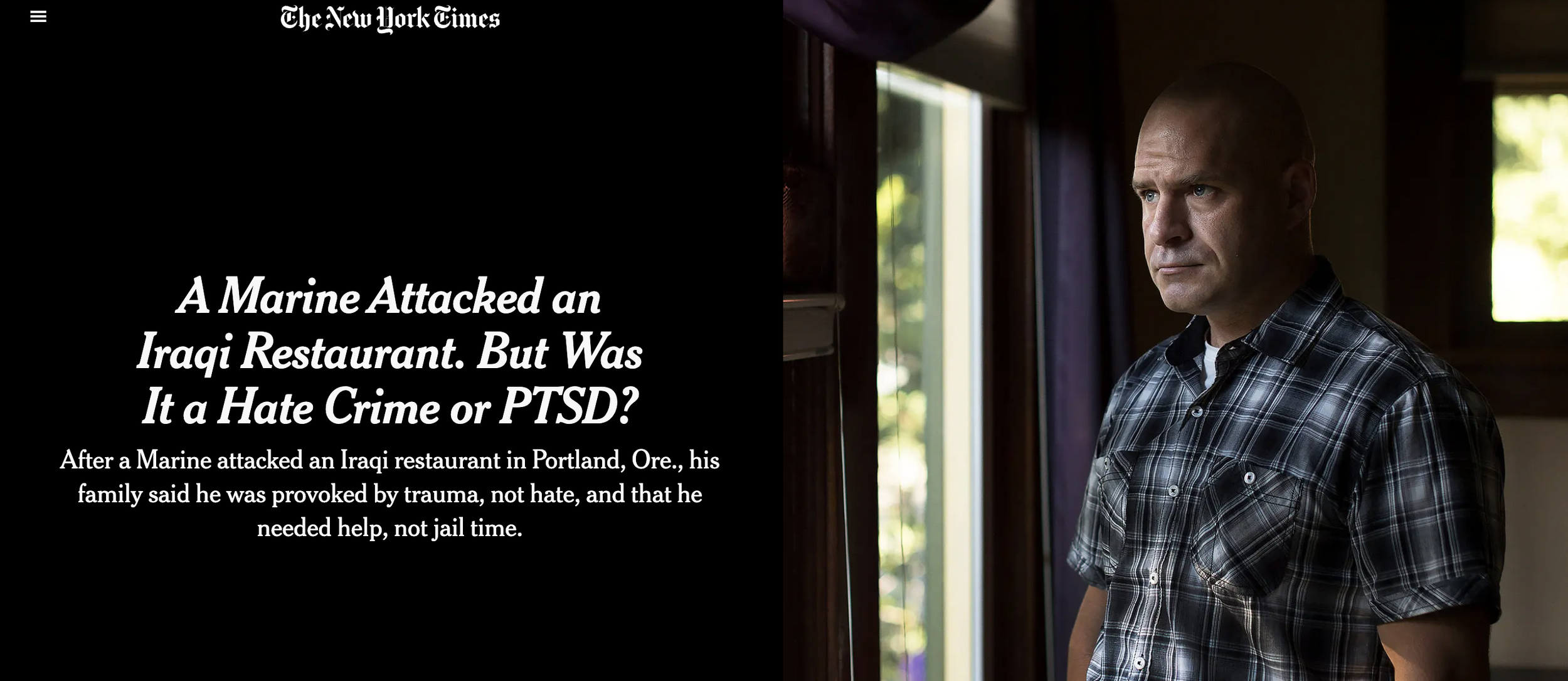
It also contains errors I'll address in the next installment.
What matters here is scale. The story ran on Page A1 of the national print edition. It was then adapted for The Daily, The New York Times' flagship podcast, hosted by Michael Barbaro — at the time one of the most downloaded podcasts in the United States, with an audience of millions.
Whatever distortions had accumulated in Portland's local coverage were now traveling at a different velocity entirely.
I'm still working to obtain the full transcript of The Daily episode. When I do, we'll take a close look at what a mass audience was told — and what they weren't.
The story isn't over. It gets worse before it gets better. Stay with me.
Help #GIJustice by taking action:
Contact the Portland Police Bureau Public Information office and demand they take responsibility for mischaracterizing ORS 166.155.
📞 503-823-0000
Email The Oregonian director of public interest and accountability Laura Gunderson and demand a retraction and an apology to Damien Rodriguez.