NotMyGospel 4: "And Friends"
On September 11, 2011, I stood on a stage at World Cafe Live in Philadelphia wearing chains.
Not metaphorical chains — actual chains, physical ones, the same that held my dog tags in Iraq. The date was intentional. Ten years after the towers fell, I was one of the veterans Shane Claiborne had assembled for an event called Jesus, Bombs, and Ice Cream: a live performance about war, military spending, and the possibility of a different way forward. Ben Cohen — of Ben & Jerry's — was there. Terry Rockefeller, whose son died on 9/11 and who had helped found Families for Peaceful Tomorrows, was there. Artists, musicians, a juggler, a metalworker. And me.
I opened with Genesis. Cain, the first person to kill another human being, sentenced to wander. "A burden too great to bear," he said. I told the room I knew something about that.
I'd deployed to Iraq in 2004 with an infantry platoon. I described wandering the Mesopotamian wilderness like Cain before me, watching mud bricks cure in the desert heat, coming home with a mind infected by war. I talked about PTSD, about the suicides — 17 veterans every day. I talked about becoming a conscientious objector in 2006, my infantry commander's fury, the psychiatrist who diagnosed me with "Adjustment Disorder" for having moral reservations after five years on active duty and three combat decorations.
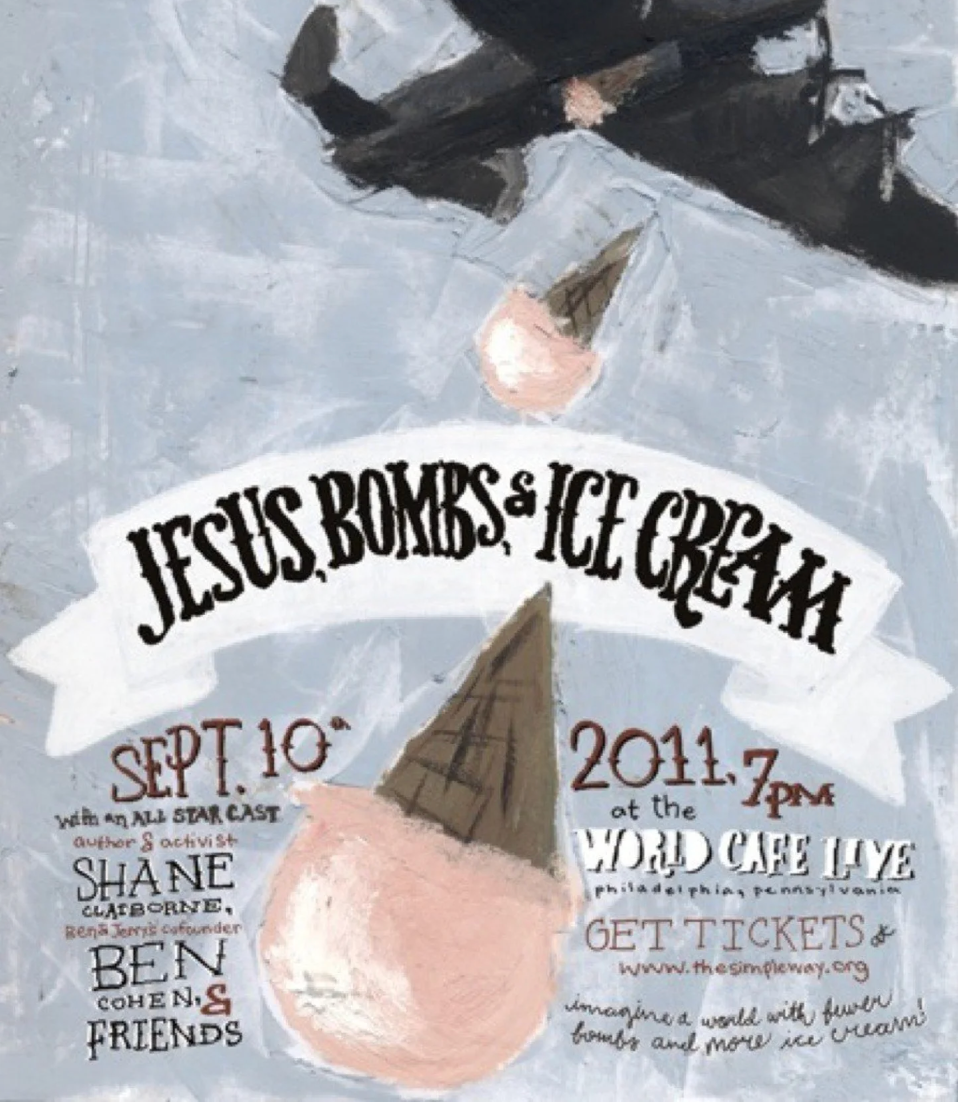
On the event poster, I was one of "an all star cast."
I talked about Saint Martin of Tours, conscripted into the Roman Praetorian Guard, who split his cape to clothe a freezing beggar, saw Christ in a vision that night, ran off to get baptized, and told Caesar on the eve of battle: "I am a soldier of Christ; I am not allowed to fight." I talked about baptism as a change of command ceremony — metanoia, new allegiance, new Commander.
The room was full of people who opposed the thing that had made me who I was. I was, at the time, all-in with Shane and with The Simple Way. I believed we were on the same side. I had been to Iraq with this man less than two years before. I signed the release form that same day it arrived.
"A Few Friends Volunteer"
Shane's January 2, 2012 email to the fourteen or so participants is worth quoting precisely, because every word of it did work:
"As you know we had a few friends volunteer to capture the event on video with the hopes that the message could have fruit beyond that one night... It feels like a natural progression to make the content available in another form... a small DVD/study resource... Proceeds will go to the nonprofit at The Simple Way (The Simple Way will also be funding this project and working to recoup costs from sales, all other monies going to work of the nonprofit)."
Volunteers. Small resource. Nonprofit cost recovery.
I mailed my signed release back that same day, under my name at the time, Logan Mehl-Laituri. The release granted The Simple Way broad rights to use, sell, and distribute my content. I figured the costs were very low — a few thousand dollars for travel and production. That was what the email implied. That was what I consented to.
Five months later, on May 23, 2012, The Simple Way signed a contract with Zondervan — the largest Christian publisher in the United States, part of HarperCollins — worth $26,000. The contract included $16,000 specifically for video production. A for-profit LLC received exclusive digital distribution rights and placed the content behind a subscription paywall.
In that contract, Shane warranted to Zondervan that The Simple Way was "the sole author of the WORK and sole owner of the rights granted in this Agreement."
Nobody told the veteran whose testimony directly contributed to the work.
"And Friends"
When the product appeared on Amazon, it was listed as: Shane Claiborne, Ben Cohen, and friends.
And friends.
My name — whatever version of it — did not appear anywhere a consumer or publisher would find it. Shane included it in the body text of the study guide and in a script for a video segment he recorded. But cover credit, online listing, any attribution a literary agent or editor might actually check: nothing. The testimony I gave on the tenth anniversary of September 11, which became a chapter in a Zondervan publication, was credited to "and friends."
This matters because I was trying to build my credentials as a veteran writing about faith and war, in a market that had no such voices. The same month JBIC shipped from Zondervan, my own book — Reborn on the Fourth of July — launched from InterVarsity Press. I was building a body of work. I had standing, expertise, hard-won credibility in a niche that the largest Christian publisher in America had never thought to develop.
I was building credentials. Someone else was building a platform on top of me, burying me before I could even get on my feet. But I didn't know what I didn't know. At least not yet.
What Happened While I Wasn't Looking
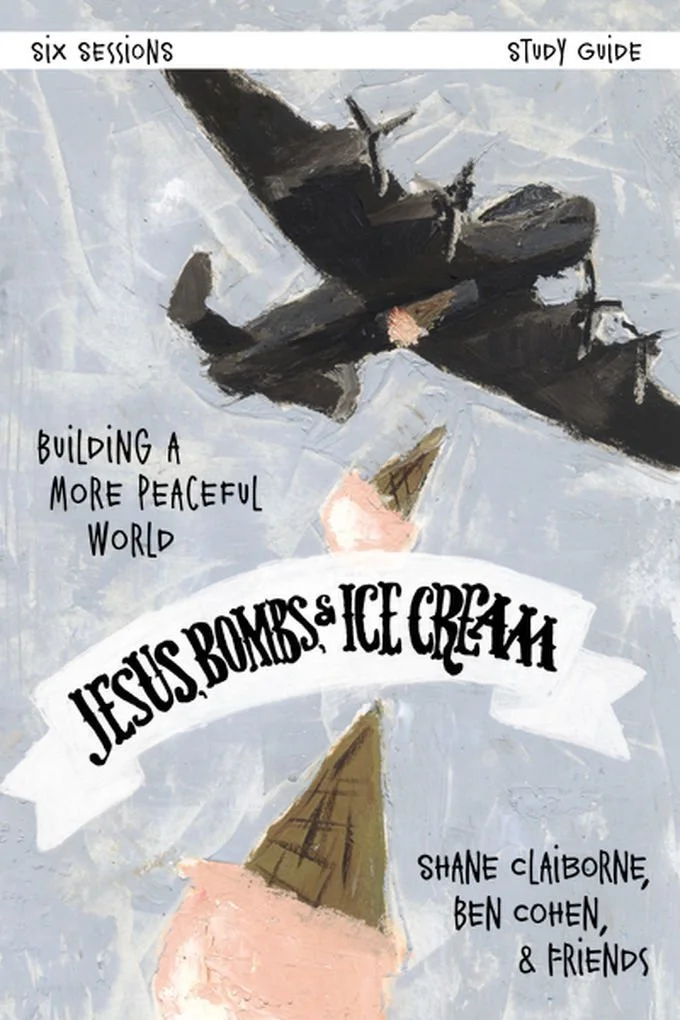
JBIC cover (Zondervan, 2012)
Between January 2012 and roughly 2018, I knew the product existed in some form. I didn't know it had gone to Zondervan. As far as I understood it, it was a small spiral-bound booklet I was given, which looked like it was printed at Kinkos.
By 2018, I had enough critical distance to see the commercial version for what it was. Spiffed up is the phrase that came to mind: the modest resource had become a product with Zondervan's distribution behind it, and I hadn't been informed. I'm not sure any of my fellow creators was.
By 2020, I needed publishing credentials. I was working with a literary agent on a book proposal for God Is a Grunt — veterans and faith, an underserved market niche where I had both standing and expertise. I listed JBIC on the proposal. Of course I did. It was a Zondervan publication, a press my agent called the "big cheese" in the Christian publishing industry. What I didn't know — what I wouldn't know until The Simple Way's attorney eventually produced the contract — was that Shane had received $26,000 for it.
That was a shocker.
The Gatekeeper
In July 2020, my agent submitted God Is a Grunt to Stan Gundry — Senior Vice President and Publisher at Zondervan, one of the most influential figures in Christian publishing. I had listed my JBIC involvement as a credential.
Gundry's response, which my agent forwarded, was that he did not know what to think of me as an author. The name Logan Isaac, he said, was not associated with those books so far as he could tell. He questioned whether I had been a ghostwriter, or was using a pseudonym. He called it "a curious situation." He rejected the proposal and advised my agent to find out what my "alleged relationship" to the Zondervan titles really was before submitting elsewhere.
I had earned those credentials at genuine cost. I had worn by Army 'chains' on a stage in Philadelphia on the tenth anniversary of September 11 and told a room full of strangers what war does to a person, and what God did with what war had done to me. My deeply personal testimony had been extracted, commercially published, and credited to "and friends." And now the most powerful gatekeeper in my target market was treating my claim to it as a probable fraud.
I've since learned I'm not the only veteran writer who has run into this wall. The pattern is larger than one proposal. But the mechanism in my case had a specific author: the failure to credit, which produced the invisibility, which produced the credibility question, which produced the rejection.
Zondervan does not publish titles by or for veterans, a federally protected class.
My agent had advised me, before any of this unraveled, not to push the credit issue — it wouldn't cross a "de minimis threshold." That advice proved catastrophically wrong. A mistake the damage for which my agent could evade, which she did, by dropping me when I pushed back against the bid cheese and its stranglehold on the American Christian imagination.
The Fight
When I contacted The Simple Way in early 2020 to renegotiate the release, they expressed no interest. In February I formally rescinded all rights. In April, HarperCollins reverted the rights back to TSW. By July, I found the content still being sold online and still behind a paywall.
I navigated all of this without legal representation, against an organization that had retained an attorney. I made three specific demands: a copy of the reversion letter confirming rights had actually been reverted, confirmation that TSW was actively managing its agents at HarperCollins to ensure my work wasn't still generating revenue, and Shane personally contacting Gundry to confirm my involvement.
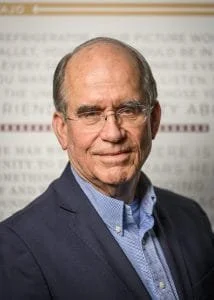
Stan Gundry in 2020. Click for source.
Shane sent Gundry an email on August 3, 2020. I was bcc'd. In it, he confirmed my participation — I was among "about 10 folks who contributed to the 90 minute event back in 2011" — and noted I was "listed as Logan Mehl-Laituri" in the credits. Then he added: "Logan's books and videos are no longer available on our websites because of his own requests/demands, though I continue to believe in his message and work."
His own requests/demands.
The only time I ever used the word "demand" in that entire correspondence was on February 13, 2020, when I informed Shane, Leroy Barber, and Caz Tod-Pearson that I would send demand letters to Work of the People and Zondervan if TSW refused to negotiate by a specified date. That is not an unreasonable demand. That is a deadline.
Shane's phrasing — chosen for an audience that included the publishing house that two days prior had rejected my proposal over "reservations about the size of the readership for the book" — framed my good-faith attempt to protect my rights as petulance. My agent was now reluctant to approach anyone at HarperCollins. She feared for her relationships with editors at "the big cheese."
In my final letter in that exchange, I wrote:
"Erasing the erasure of my work is not justice, but at least it is on my terms."
The Verdict
I don't think Shane planned any of this. I think he is naive enough and narcissistic enough that he genuinely didn't see the problem until I named it, at which point the offense at my naming it drowned out whatever conscience was stirring. That's being charitable.
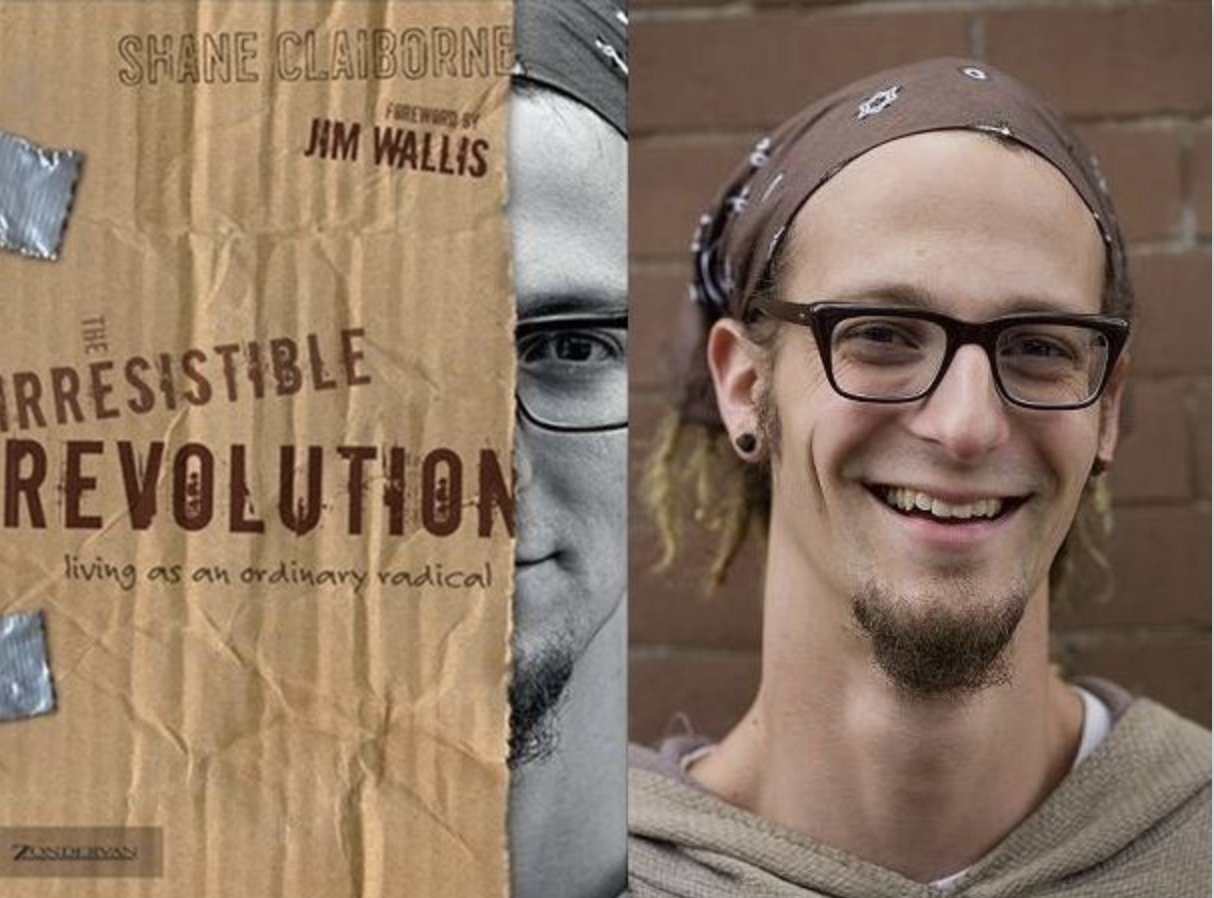
Shane published his first book, with Zondervan, a few months before we met.
The precise analogy isn't predation. It's negligent assault — the kind where the perpetrator's own stated values should have prevented it. You cannot be a progressive Christian and exploit a federally protected class out of the value of their work, even without intent. Veterans are a federally protected class. My testimony — about combat, about conscience, about what the military extracts from a human being — was my intellectual property, given under false pretenses about the scale and commercial nature of the project, exploited without disclosure, and then turned against my professional credibility when I tried to claim it.
Shane's only defense is ignorance. The problem with that defense is that he built his entire platform on prophetic consciousness about exactly these kinds of power dynamics. You don't get to preach against empire and plead civilian innocence when you exercise imperial power carelessly. The literal conscientious objector gets no conscientiousness from the people who claim to champion conscientious objection.
The event was called Jesus, Bombs, and Ice Cream — an attempt to hold together things that don't belong together, to make the jarring adjacency of faith and violence legible to an audience that mostly encounters one without the other. I understood that project from the inside, in a way most people in that room did not.
What I didn't understand was that the project had a different economy than the one I'd been sold.
The bombs were mine to carry. The ice cream, not so much.