What OSU Celebrates, and What It Bans
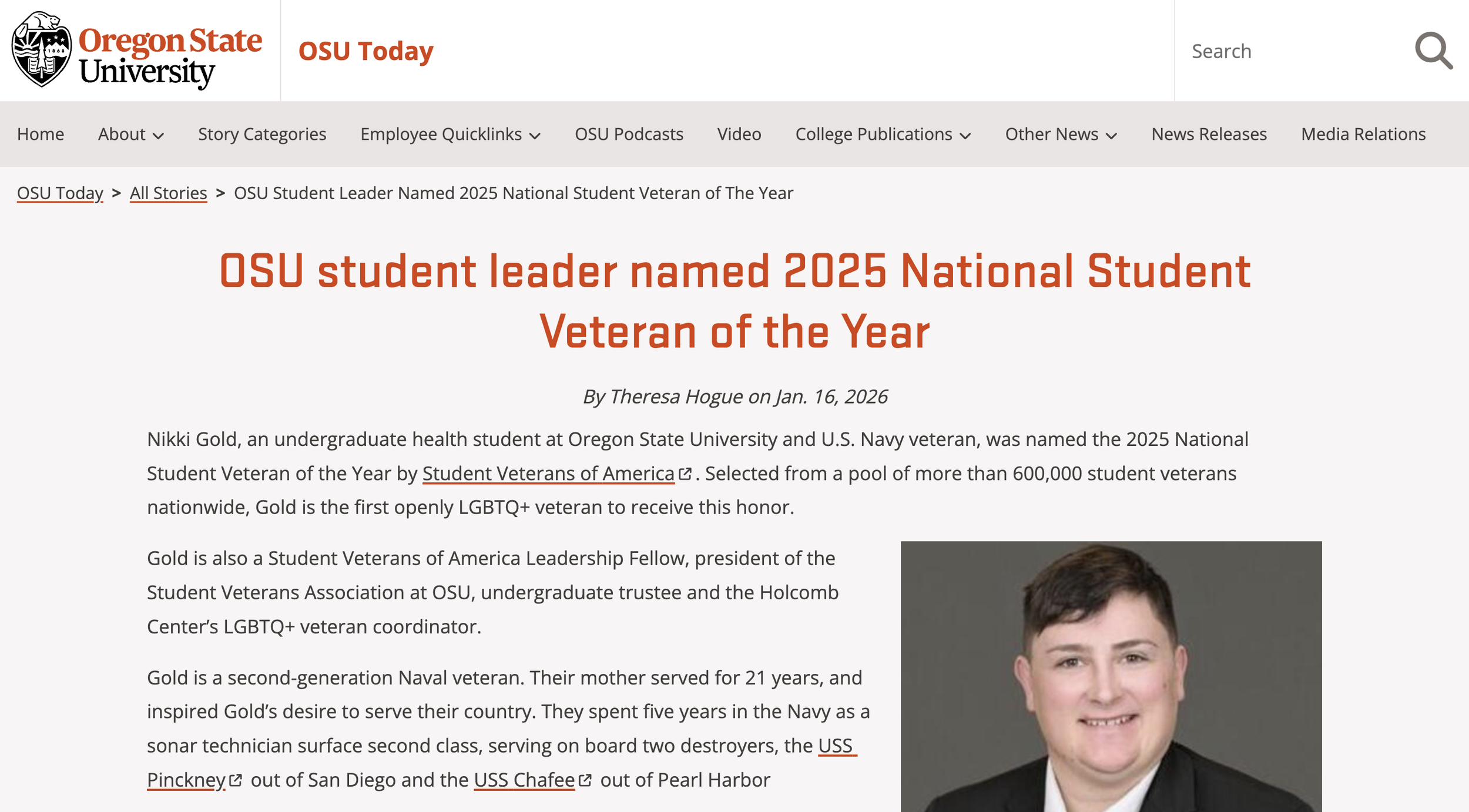
OSU profile of Student Veterans of America chapter president Nikki Gold. Click for source
The Oregon State University media department recently published a profile of Nikki Gold, named National Student Veteran of the Year by Student Veterans of America. Gold's story is genuinely compelling; a Navy sonar technician who found community at OSU's Holcomb Center, built a peer support group for LGBTQ+ veterans, and distributed 60 weapon safes to student veterans struggling with suicide risk. If that's what you measure, Gold earned the recognition.
I have no argument with Nikki Gold.
I have an argument with Oregon State University.
I spent the last eighteen months trying, through every proper channel I could find, to reach OSU's student veterans with information directly relevant to their civil rights and their lives. My children are enrolled in KidSpirit through OSU. Until May 7, 2025, I was a familiar face at the Holcomb Center.
On that date, Officer Beaton of OSU's Department of Public Safety called my cell phone to inform me I had been issued an exclusion order from Oregon State University and all OSU state-owned or controlled property statewide. Twenty-three thousand acres. No end date. The stated reason: "creating a disruption." The alleged disruption was a private conversation, in a closed office, with Holcomb Center Director Willie Elfering — a conversation he initiated, in a room he asked me to close the door to, after which I walked out without incident.
The written notice was not served to me. It was handed to my partner while she brought our children to gymnastics class on campus.
Under the exclusion, I could not take my children to their activities on public property. I could not return library books. I could not accept Lyft passengers who requested a ride from campus. I could not attend the OSU Extension small farms program I participate in as a disabled veteran. I appealed within the five-day window, offered to apologize, and provided character references. OSU missed its own seven-day deadline to respond. The answer arrived by mail, weeks late.
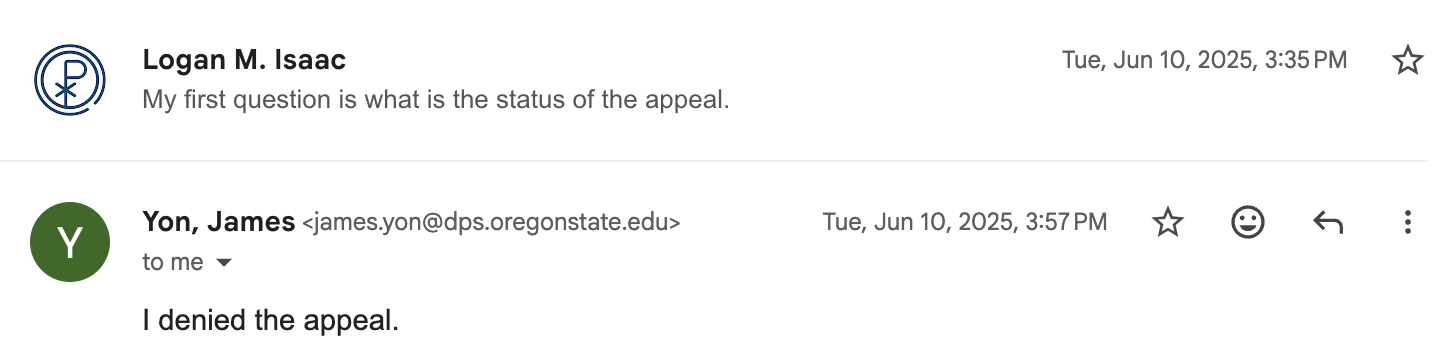
The exclusion expired eight months later, on January 22, 2026. Five days after that, OSU's veteran services apparatus received the highest national recognition its industry offers
I want to be precise about what I am not saying. I am not saying Gold's advocacy is illegitimate. I am not saying the Holcomb Center does nothing of value. What I am saying is that an institution can distribute weapon safes, win national awards, and still function simultaneously as an exclusion mechanism for veterans who don't fit the profile it finds comfortable.
In December 2024, I testified before the Oregon Senate Veterans Committee. Using OSU's own Equal Opportunity and Access data, I documented that veterans are disproportionately represented in the university's lowest employment tiers, and that the Holcomb Center's physical placement on campus enforces invisibility rather than inclusion. That testimony is on the public record.
The institutional math, in the end, is simple: a veteran who publicly names a problem gets banned. A veteran who serves the institution's preferred narrative gets celebrated nationally.
OSU's veteran community deserves both. What it has is only one.
Logan M. Isaac is a combat veteran of the 25th Infantry Division, a professed monk, and the author of God is a Grunt. He lives in Albany, Oregon