The Masks Tell You Everything
Economic Conscription and the Minneapolis Raids
In August 2025, the Department of Homeland Security announced it was removing all age caps for ICE law enforcement positions. Applicants as young as 18 could now apply, with no upper limit. The incentives were explicit: $50,000 signing bonuses, student loan forgiveness, enhanced retirement benefits, and extensive overtime. Within a week, more than 80,000 Americans applied.
By December, some of those recruits were in Minneapolis wearing masks.
When federal agents began large-scale immigration enforcement actions in the Twin Cities, the images that circulated were strikingly uniform: officers in tactical gear, faces covered, no visible names or identifying information. Official explanations emphasized officer safety. But the masks told a deeper truth. They were not merely tactical. They were theological.
I recognized that recruitment pitch immediately. I heard a version of it as a senior in high school, before 9/11 transformed the poverty draft into a generation-long war. I grew up in a town with few prospects. The Army offered money for college, job training, and a way out. I took it. So did most of the people I served with. We were not ideologues. We were young, broke, and running out of options.
The tens of thousands who applied to ICE last summer were not responding to a sudden surge of patriotic fervor. They were responding to economic desperation — the same force that has always supplied the bodies for American violence. The masks they now wear are not symbols of zeal. They are signs of shame.
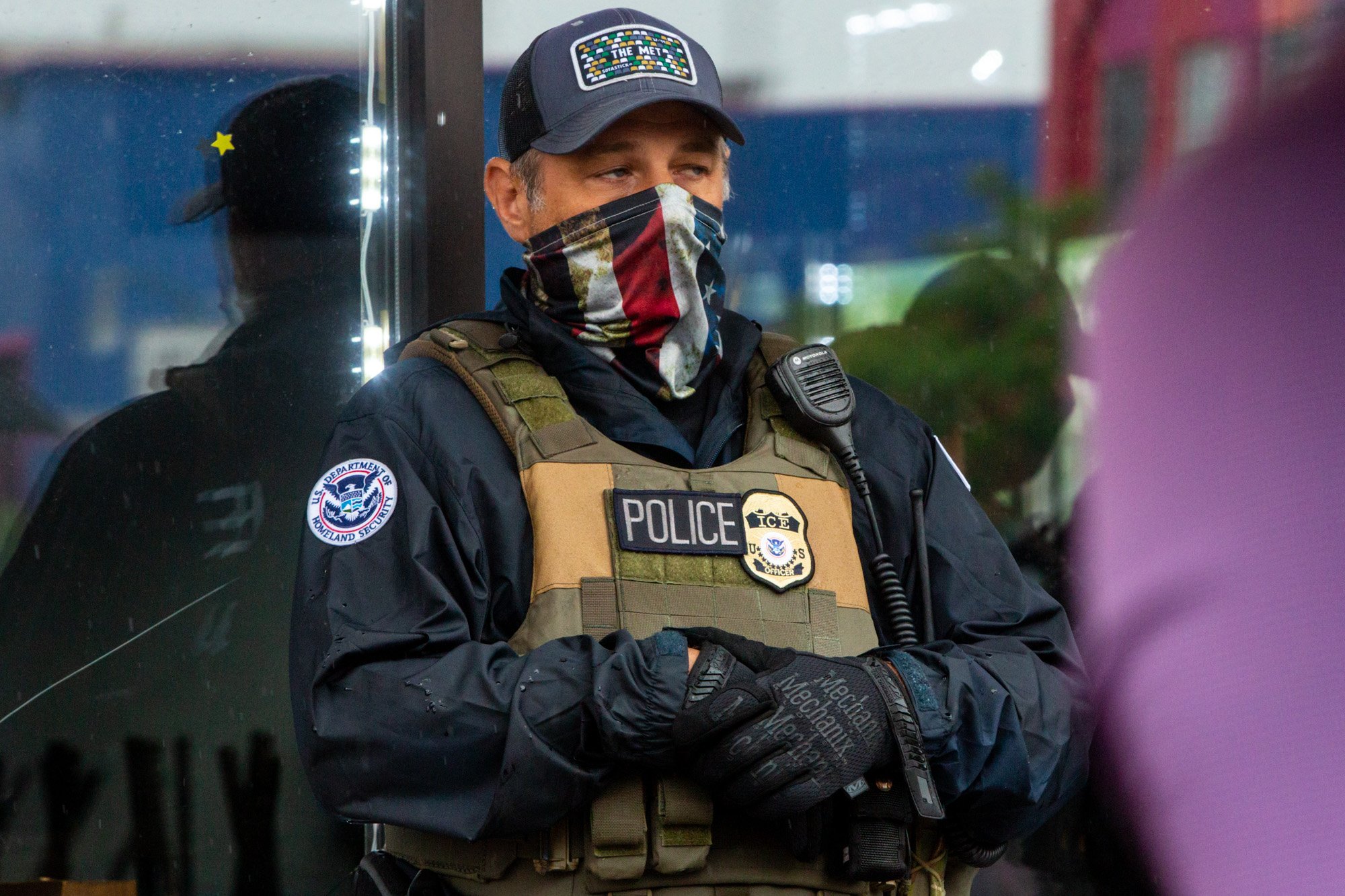
Photo by Nicole Neri for the Minnesota Reformer. Click for source
Hiding From Relationship
Christian theology begins with a scandal: God takes on a face. The doctrine of the Incarnation insists that salvation does not occur through abstraction, distance, or anonymity, but through presence — through a body that can be seen, named, and held accountable. God enters relationship.
The masks in Minneapolis represent the inversion of that claim. They are the visual grammar of a system that requires the refusal of relationship. These officers are not meant to be known by the communities they police, or even by their neighbors. They are rendered interchangeable, faceless, and unaccountable by design.
This is often justified as prudence. But theology has language for what is actually happening. The masks function as a preemptive defense against moral injury. They allow agents to administer violence while anticipating the need to hide from its consequences. They do not proclaim conviction. They confess unease.
In God Is a Grunt, I argued that the ritualized phrase “Thank you for your service” operates as a modern scapegoat mechanism. Civilians offer gratitude not to honor soldiers, but to avoid reckoning with what has been asked of them. The Minneapolis masks reveal the same mechanism in reverse. Here, the enforcers hide their faces because the absolution has not yet been granted. The mask becomes an inverted confession: I am doing what the state requires, and I will need forgiveness later.
If this work were experienced as righteous, it would not require anonymity.
Beyond Heroes and Villains
Our political narratives depend on flattening the people behind those masks into moral caricatures.
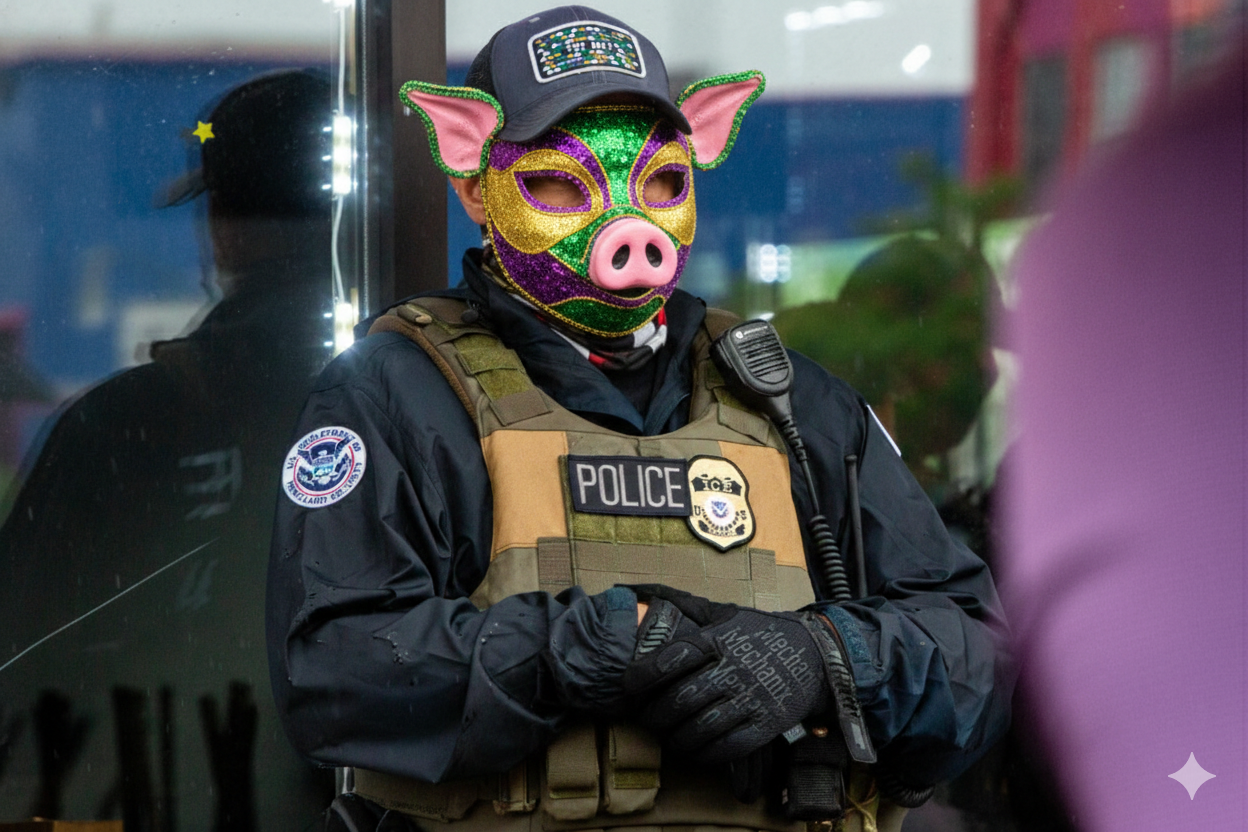
The caricatures are just writing themselves at this point...
Conservative rhetoric casts them as heroes — patriots enforcing the law against dangerous criminals. This story must ignore the economic inducements that made the work attractive in the first place. It must also overlook the human cost borne by communities subjected to aggressive enforcement.
Progressive rhetoric often casts the same agents as villains — fascist stormtroopers gleefully carrying out cruelty. This narrative, too, relies on denial. It erases the poverty draft that has fed both the military and domestic enforcement agencies for generations. It pretends that people drowning in debt or aging out of viable work are making purely ideological choices rather than coerced ones.
Both stories perform the same function. They protect the system by isolating moral responsibility in individuals. If the agents are heroes, we can celebrate them. If they are monsters, we can condemn them. Either way, we are spared from asking why tens of thousands of Americans were willing to do this work for a paycheck.
Scapegoating always works this way. It concentrates guilt in a visible group so the structure that produced the violence can remain unexamined.
The masks signal that the agents themselves already understand this. They anticipate their eventual role as scapegoats — the ones who will be blamed when public sentiment turns, the ones who will be told they “should have known better,” even as the institutions that recruited them quietly move on.

It's never really about the scapegoats, it's about the community that demands them.
Economic Coercion as Moral Injury
Moral injury does not begin with a bad act. It begins with an impossible choice.
Economic conscription presents itself as opportunity, but it functions as coercion. It narrows the field of imaginable futures until violence appears as the only viable path forward. When the state offers large sums of money to perform work that requires hiding one’s face from one’s community, it is not offering neutral employment. It is outsourcing its moral risk to the poor.
This is not a partisan phenomenon. It is bipartisan, structural, and deeply American. We have perfected a system that turns economic precarity into a renewable resource for enforcement — military and domestic alike — while laundering the resulting harm through narratives of service, legality, or inevitability.
Christian ethics cannot accept this arrangement without distortion. A theology that blesses coerced violence while absolving the structures that necessitate it is not realism. It is idolatry.
What Faithful Witness Requires
I have been contacted by chaplains asking how to speak about these raids with the soldiers they serve. Some of those soldiers are watching the same recruitment ads. Some are weighing their options as enlistments end. They recognize the calculus. I did too.
The pastoral task is not to baptize bad choices or to demonize desperate people. It is to tell the truth. Economic desperation is not calling. Anonymity is not neutrality. And a mask is not just equipment. It is often a warning from the conscience that the paycheck is asking for more than it should.
A credible Christian response refuses the binary that sanctifies violence on one side and absolves it as unavoidable on the other. It insists on naming the system that profits from moral injury while assigning its costs to individuals least able to refuse.
And it asks a question simple enough to pierce the rhetoric: What does it say about the work when the workers cannot show their faces to the people they are sent to confront?
The Masks as Witness
I am a combat veteran, a professed monk, and someone who works daily with veterans navigating the aftermath of choices made under pressure. I know what economic conscription looks like. I know what moral injury feels like. And I know how institutions behave when they need bodies to do violence without paying the political cost.
They find people with no other options. They offer just enough money to make coercion look voluntary. They wrap it in the language of service. And when the work requires hiding from fellow human beings, they call it safety rather than what it is: a refusal of relationship.
The masks worn in Minneapolis are not incidental. They are a form of witness. They testify to a truth the recruitment materials cannot say aloud: this job will require you to become someone you cannot introduce to your neighbors.
That is not law enforcement. It is not public service. It is a scapegoat system that depends on anonymity to function. The masks tell us everything — if we are willing to see what they are already confessing.