NotMyGospel 3: Production on the Fast Track
This is part of a series on “The Gospel of Rutba” I’m calling #NotMyGospel.
On February 26, 2012, Greg Barrett finally sent me the manuscript for The Gospel of Rutbah. I'd been asking to see it for months. My own book, Reborn on the Fourth of July, was scheduled for release by InterVarsity Press on June 16, 2012. Greg's book would be published six days later, on June 22.
Shane Claiborne had helped me get my book project off the ground. He was on my IVP influencer list, received advance copies, and knew my manuscript well. And then his project with Greg was scheduled to release the same week as mine, telling a different version of the same story—one where I appeared as a character rather than as an author, as a problem to be debated rather than a person with analysis worth hearing.
I had one week before my spring break ended to review how Greg had portrayed me using my private journals and my experience as a combat veteran.
What followed was two weeks of increasingly desperate attempts to get Greg to include basic accuracy in his portrayal of me, culminating in a realization: time pressure wasn't an unfortunate constraint. It was the coercion tool.
"Production on the Fast Track"
On March 7, I wrote to Greg Barrett and Robert Ellsberg (the publisher at Orbis Books) that I needed to provide "overall reflections on the part my character plays in the overall narrative" and "a bullet point list of revisions I suggest, as well as things that are less flexible for me."
I added: "Having seen this so late in the game, I am worried I might not be able to deal with it as patiently and reflectively as I would prefer."
By March 14, things had deteriorated completely.
That morning at 6:59am, I wrote:
If you need to flatten my character in the interest of time, then you don't need my help as much. If you want to improve on it, and make it 'all that it can be,' then we need to have a lengthier discussion and be prepared to dig in deeper.
Less than an hour later, Greg responded:
Production right now is on the fast track. Lengthier discussions and digging deeper is out of the question. However, if you want to reopen your journals for use, your own thoughts and words written and recorded from the 2010 trip, that could maybe add some depth.
Read that carefully. Greg couldn't make time to portray me accurately, but if I'd surrender more material from my private journals, which I'd explicitly shared in confidence, that might help him out.
An hour after that: "Send your suggested revisions. Keep in mind Logan, nothing is required. We're bending over trying to accommodate you."
Robert, the publisher, backed him up:
I understand your feelings about what would be required to really do justice to your character, but I don't see how we have time to do that.
Robert Ellsberg is Daniel Ellsberg's son. He grew up watching his father risk everything to expose how institutions weaponize process to suppress truth about war. Robert knew how "not the right time" becomes "never the right time." How deadlines flatten inconvenient truths.
He chose the production schedule anyway.
What Greg Said When the Mask Slipped
By that afternoon, after hours of increasingly hostile emails, I wrote to Greg: "
I was responding to you personally because I figured you wouldnt want your dirty laundry aired (do you want him to know you called me a mother fucker and referred to me as 'boy', and that that is why i will not have a one-on-one with you?). I don't want to be in the book, and I never did.
Greg had verbally abused me during phone conversations, using condescending language he later explained away by calling himself "just an old redneck and ex-boxer." Now he was using time pressure to force me to either accept being misrepresented or be blamed for delaying publication.
On March 1, Greg had written: "
When you asked to join the reunion trip to Rutba you injected yourself into this story... As a journalist it's difficult for me to tell the story of Rutbah authentically, honestly, without including your history and your perspective gleaned by me during the return of 2010.
Your presence is essential to my story's "authenticity," but your actual analysis can be ignored.
Shane's "Critical Importance" That Changed Nothing
On March 2, 2012, Shane sent an email to Greg and Robert, copied to me:
It is critically important to me that Logan feel good about this book and in particular that he not feel misrepresented. I want to encourage you to connect with Logan about any rewording or editing he recommends. I know you are on a tight timeframe and ready to go to print soon, but this is a really important thing to be resolved.
This is Shane's only documented response to learning I was fighting for accurate representation.
He wanted me to "feel good." He wanted things "resolved." But he didn't push back on the timeline. He didn't question whether Greg's approach was exploitative. He saw asserting rights over one's own likeness as merely a 'recommendation' rather than a legal and moral obligation.
It was "critically important" that I express the proper feelings. But not important enough for him to actually do anything about it. Shane knew my book was coming out in June. His silence about the competition—competition he'd helped create—was a choice.
The Week Everything Happened
Saturday, June 16, 2012: Reborn on the Fourth of July published by InterVarsity Press.
Tuesday, June 19: I was interviewed on WUNC's The State of Things by Frank Stasio—a significant regional public radio show, exactly the platform that could launch a book. Before we went on air, Frank asked if I was willing to discuss Rutbah.
I declined. I told him I hadn't figured things out yet.
I hobbled my own book launch to protect Shane, Greg, and Sami Rasouli. I couldn't yet name what had happened as exploitation. I was still operating under the assumption that these were my people, my community. Meanwhile, Greg's book was launching three days later with Shane's full promotional machine behind it.
Frank Stasio knew there was a story there. He wouldn't have asked otherwise.
Thursday, June 21, 9pm: Wild Goose Festival, Exodus Stage—the main venue. Not my poorly-attended speaking slot for my book elsewhere at the festival, but their prime-time slot for Greg's book launch.
Shane had been drafting the script since May 11. I was given 3 minutes to explain "why I went." I tried to include the complexity—the security decision that prevented reconciliation, the living will I wrote before going, my ongoing struggle with how things unfolded.
On June 1, Shane sent back my draft with edits: he'd cut the two paragraphs that complicated his triumphalist narrative. Gone was the security decision. Gone was the actual outcome. What remained was sanitized enough to serve the book launch.
By June 10, I wrote to Shane:
i dont think i've felt very well heard in this years-long chain of events... i feel like the only one willing to hold the pieces together... and it is terribly exhausting... i just recently realized how to put how i feel about some things to words.
On June 21, I stood on that stage and performed my scripted 3 minutes while Shane, Jonathan, and Greg hovered behind me to ensure I was properly promoting The Gospel of Rutbah. They used my book launch venue to promote their competing book about me.
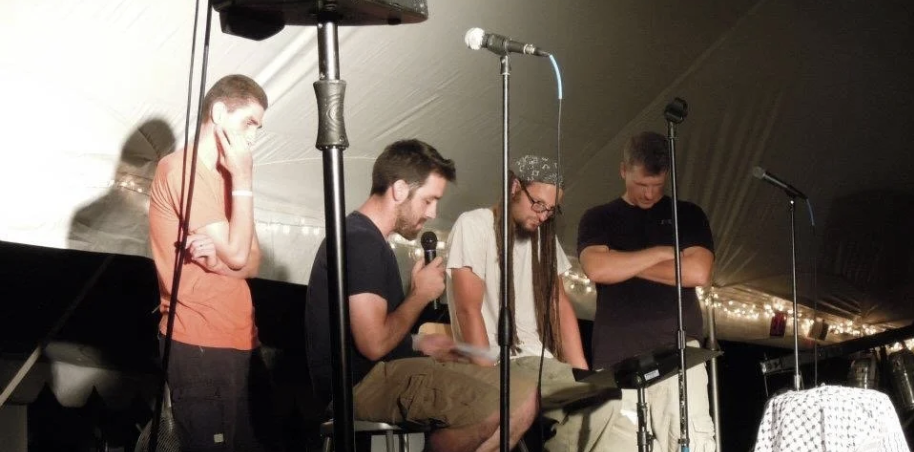
My IVP editor took this picture for their book with Orbis.
Friday, June 22: The Gospel of Rutbah published by Orbis Books.
This is how progressive peace theology's relational manipulation works. You internalize the values of community, reconciliation, and grace so deeply that you silence yourself rather than complicate the mission. The exploitation doesn't require conspiracy. It just requires that the exploited party be trained—through theology, through relationships, through institutional pressure—to value everyone's wellbeing except their own.
How Englewood Review Validated the Flattened Character
On August 10, 2012, Englewood Review of Books published their review of Reborn on the Fourth of July. The title: "An Embrace of Self-Denying Martyrdom." The reviewer noted the trip to Rutbah "forced him to face his violent past even further, but also helped bring him again to redemption."
Two weeks later, on August 24, Englewood Review published their review of The Gospel of Rutbah. The title: "A Mirror to the World."
Here's what they said about me as a character in Greg's book:
He aches to talk about the struggles he has experienced during his service, and to apologise as well, but the chance never arrives... Logan wants so much to lessen his own burden, but the reader is asked implicitly whether he has a right to 'impose' his own needs on the broken landscape in Iraq. It's a fascinating discussion-starter for the ethics of reconciliation and peacemaking.
Put these side by side:
In my own book: I'm embracing self-denial and finding redemption by confronting PTSD and moral injury.
In Greg's book about me: I'm trying to lessen my burden, and readers should question whether I have the right to impose my needs on Iraq, had "the chance" arrived...
Same struggle. Different framing. In my own story, my moral wrestling is praiseworthy. When that same struggle appears in a book controlled by a civilian journalist, it becomes a question of whether I have the right to my own experience.
Greg's selective editing created this reading. He emphasized my "aching" to apologize—except that was his own manufactured framing. I was never stationed in Rutbah. I was in northern Iraq, primarily Mosul. Never set foot in Anbar Province during my deployment. Greg knew this. I told him directly in Jordan that he was projecting his apology narrative onto me.
What I actually wrote in my journals was about the impossibility of “authentic” connection while being expected to hide my identity. I was wrestling with behavior policing that made solidarity impossible, I was not seeking personal catharsis.
But Greg needed a veteran character actively seeking vindictive absolution, someone whose redemption came at the expense of others. That's what sells to progressive audiences whose imagination has been trained to see scarcity and competition. And Englewood Review's critic received it exactly as Greg intended: as a "complex moral quandary" about whether veterans have the right to center their own healing. As if healing is unilateral.
What "Fast Track" Actually Means
Time pressure is coercive because it forces you to choose between being misrepresented and being blamed for delays. You can accept the flattened character, or you can be the angry veteran holding up publication, costing money, preventing the gospel from being shared.
This is manufactured urgency. Greg had been working on the book for years. He'd had my journals since 2010. He showed me the manuscript one week before my spring break ended, then declared there was no time for substantive discussion.
The timeline was the weapon.
I've put my complete Rutbah journals online at loganmartinisaac.com/rutba. All 63 pages of written entries, all 90 minutes of audio journals. The material Greg selectively quoted. The context he stripped away. The full arc of my thinking that couldn't fit into his production schedule.
You can decide for yourself whether the character Greg created—the one Englewood Review questioned—matches the person those journals reveal.
In the next part of #NotMyGospel, I'll ask why Shane chose to republish his 2003 Iraq journals rather than reckon with what happened in 2010 and 2012. It's the same pattern of narrative control, just more strategic and less principled.