Election 2024: Same Author, Same Editor, Different Rules
How the Jesuit Media Empire Applied a Double Standard to Disenfranchise Military Families, a federally protected class.
In August 2024, America Magazine — the flagship Jesuit publication in the United States — published my opinion piece criticizing Republican vice presidential nominee JD Vance for accusing Tim Walz of "stolen valor." The piece argued that Vance's rhetoric amplified survivor's guilt in a community devastated by suicide. It named both candidates in the headline, ran as part of America's Democratic National Convention coverage, and concluded that the Republican nominee should publicly retract his comments. I was paid $250 for it.
Twelve days. That's how long it took from pitch to publication. The editor, Robert Sullivan, never required a "Catholic angle." He never demanded I assess Kamala Harris's military record for balance. He never insisted on "getting a response from the Trump campaign." He never raised fact-checking concerns beyond normal editorial review.

Two months later, I pitched the same editor a companion piece. This one would have examined how Kamala Harris — as California Attorney General in 2013 when the state added "military and veteran status" to its civil rights protections — oversaw an agency that never implemented or enforced those protections. The piece would have noted that Harris sat on the Senate Judiciary Committee when a congressional letter was sent to then-Attorney General Barr about federal agencies failing to enforce military civil rights. It would have asked whether her selection of a veteran running mate was genuine commitment or tokenism.
Sullivan's response imposed every barrier he had waived two months earlier. He now required a "Catholic angle" — something entirely absent from the Vance piece he'd already published. He demanded "evidence that this is a significant problem" — though the Vance piece relied on news clips and my personal experience. He insisted on "some assessment of how Trump handled veterans' issues" for balance — though the August piece contained zero assessment of Harris's record. And he said the magazine would need "ample time for fact-checking, trying to get a response from her office."
The core facts of the Harris pitch are public record verifiable in minutes: AB556 is in the Legiscan database. Harris's tenure as AG is on her Wikipedia page. The California constitution's Article V, Section 13 compels the AG to implement new laws. The California Civil Rights Department's website can be checked for compliance. These are not contested claims requiring weeks of investigation.
When I pressed the issue, Sullivan's final answer was: "We don't have the capacity to edit and fact-check such a piece, and get a response from the Harris campaign, in the few days remaining before the election." He had never sought a response from the Trump campaign for the piece that helped Democrats.
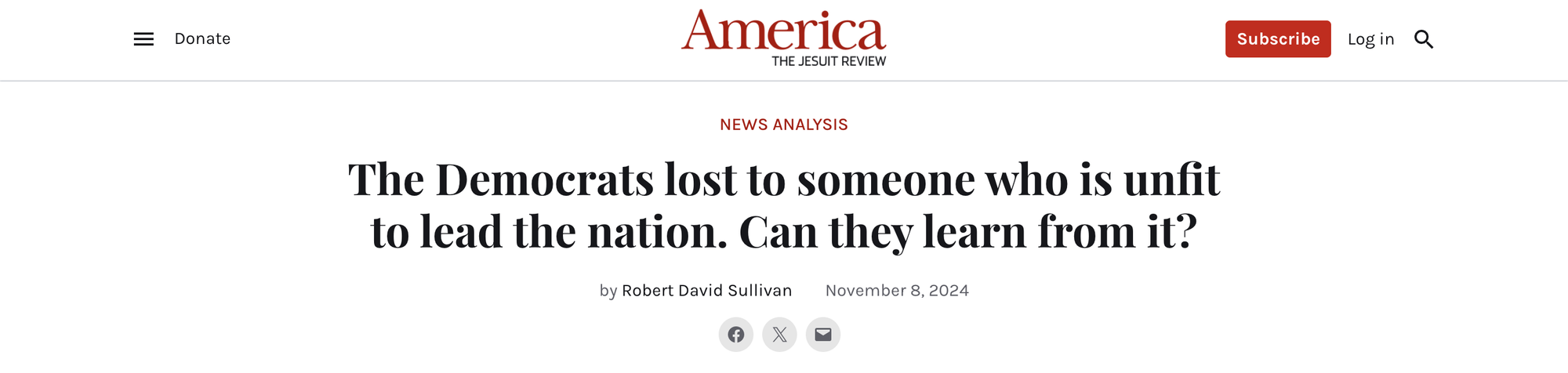
Days after Election 2024, Robert Sullivan called the former Republican candidate "unfit to lead the nation." He had paid me for an anti-GOP essay leveraging my military bona fides.
I want to be fair about what this might be. Sullivan probably wasn't sitting in his office scheming about election interference. The more likely explanation is something I've written about for over a decade: civilian bias. The Vance piece felt like a natural story because "stolen valor" was already trending. The Harris piece felt like an advocacy argument because military civil rights isn't part of the established media vocabulary. One story fit the existing narrative; the other challenged it.
But that's exactly the problem. The reason one story about military families feels "natural" and another feels like it requires extraordinary vetting is that media institutions have already decided which military stories are worth telling. A veteran correcting another veteran about combat rhetoric? That's content. A veteran pointing out that the sitting Vice President's state never enforced the civil rights law her office was constitutionally required to implement? That needs a Catholic angle, a Trump comparison, a fact-check, and a campaign response.

The result is that America Magazine's readership — which includes an unknown number of military families — went to the polls in November 2024 having read a piece that criticized the Republican ticket's treatment of veterans but never learning that the Democratic ticket's record on military civil rights was, at best, one of neglect.
This is one piece of a larger pattern I'll be documenting from #Election2024. The New York Times and others have their own versions of this story. But America is where I'll start, because the paper trail is clean, the emails are time-stamped, and the double standard speaks for itself: same author, same editor, same election, opposite rules.
If you want to see the full correspondence, it's archived at gijustice.com/record.
Logan M. Isaac is a combat veteran, Hospitaller of St Martin, and an award-winning author. He is currently pursuing federal civil rights litigation in the District of Oregon on behalf of military families. Subscribe to Martinalia for ongoing documentation of institutional failures affecting military family civil rights.