Plaintiff’s Notice
Notice Images
Notice Text
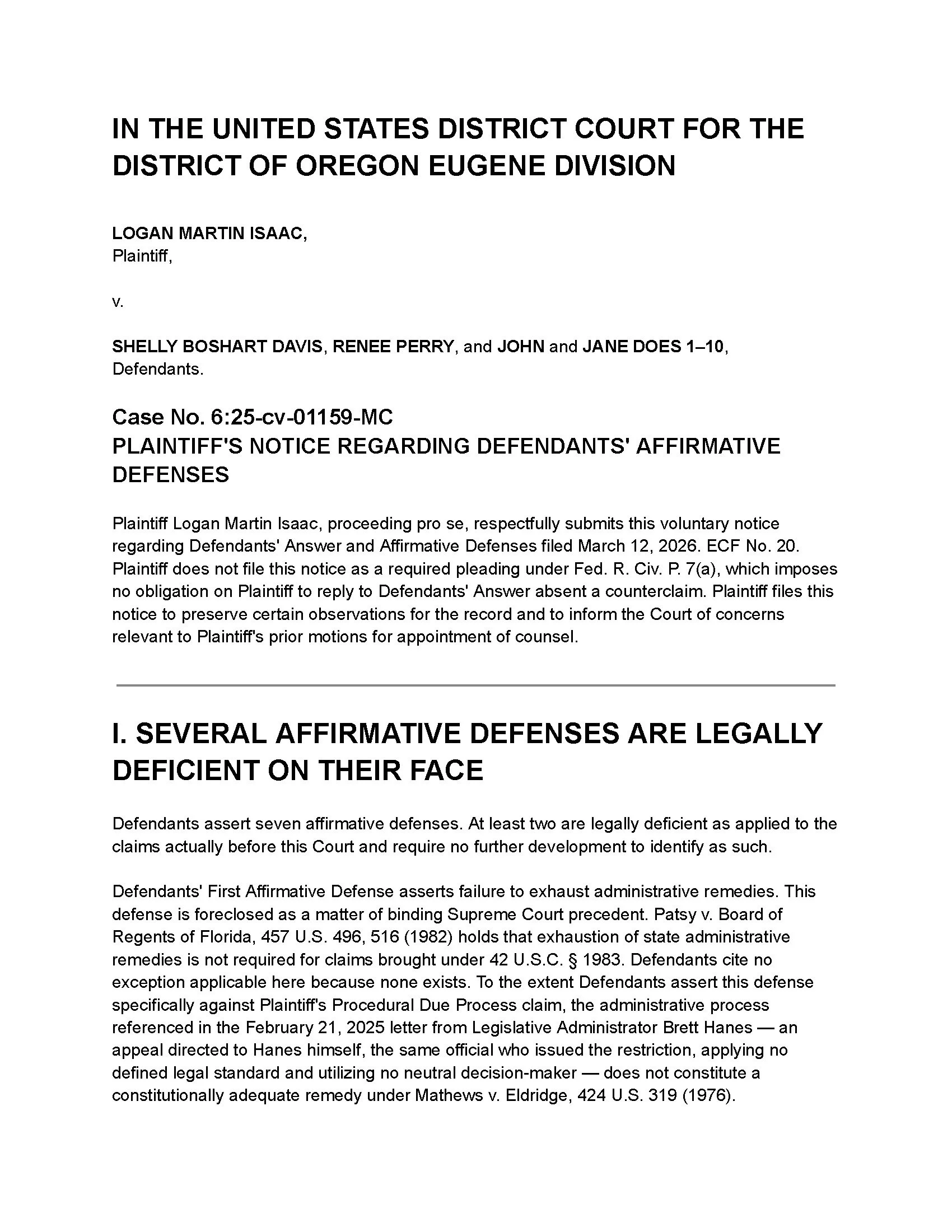
Plaintiff Logan Martin Isaac, proceeding pro se, respectfully submits this voluntary notice regarding Defendants' Answer and Affirmative Defenses filed March 12, 2026. ECF No. 20.
Plaintiff does not file this notice as a required pleading under Fed. R. Civ. P. 7(a), which imposes no obligation on Plaintiff to reply to Defendants' Answer absent a counterclaim. Plaintiff files this notice to preserve certain observations for the record and to inform the Court of concerns relevant to Plaintiff's prior motions for appointment of counsel.
I. SEVERAL AFFIRMATIVE DEFENSES ARE LEGALLY DEFICIENT ON THEIR FACE
Defendants assert seven affirmative defenses. At least two are legally deficient as applied to the claims actually before this Court and require no further development to identify as such.
Defendants' First Affirmative Defense asserts failure to exhaust administrative remedies. This defense is foreclosed as a matter of binding Supreme Court precedent. Patsy v. Board of Regents of Florida, 457 U.S. 496, 516 (1982) holds that exhaustion of state administrative remedies is not required for claims brought under 42 U.S.C. § 1983. Defendants cite no exception applicable here because none exists. To the extent Defendants assert this defense specifically against Plaintiff's Procedural Due Process claim, the administrative process referenced in the February 21, 2025 letter from Legislative Administrator Brett Hanes — an appeal directed to Hanes himself, the same official who issued the restriction, applying no defined legal standard and utilizing no neutral decision-maker — does not constitute a constitutionally adequate remedy under Mathews v. Eldridge, 424 U.S. 319 (1976). Defendants' Sixth Affirmative Defense asserts Eleventh Amendment immunity against claims
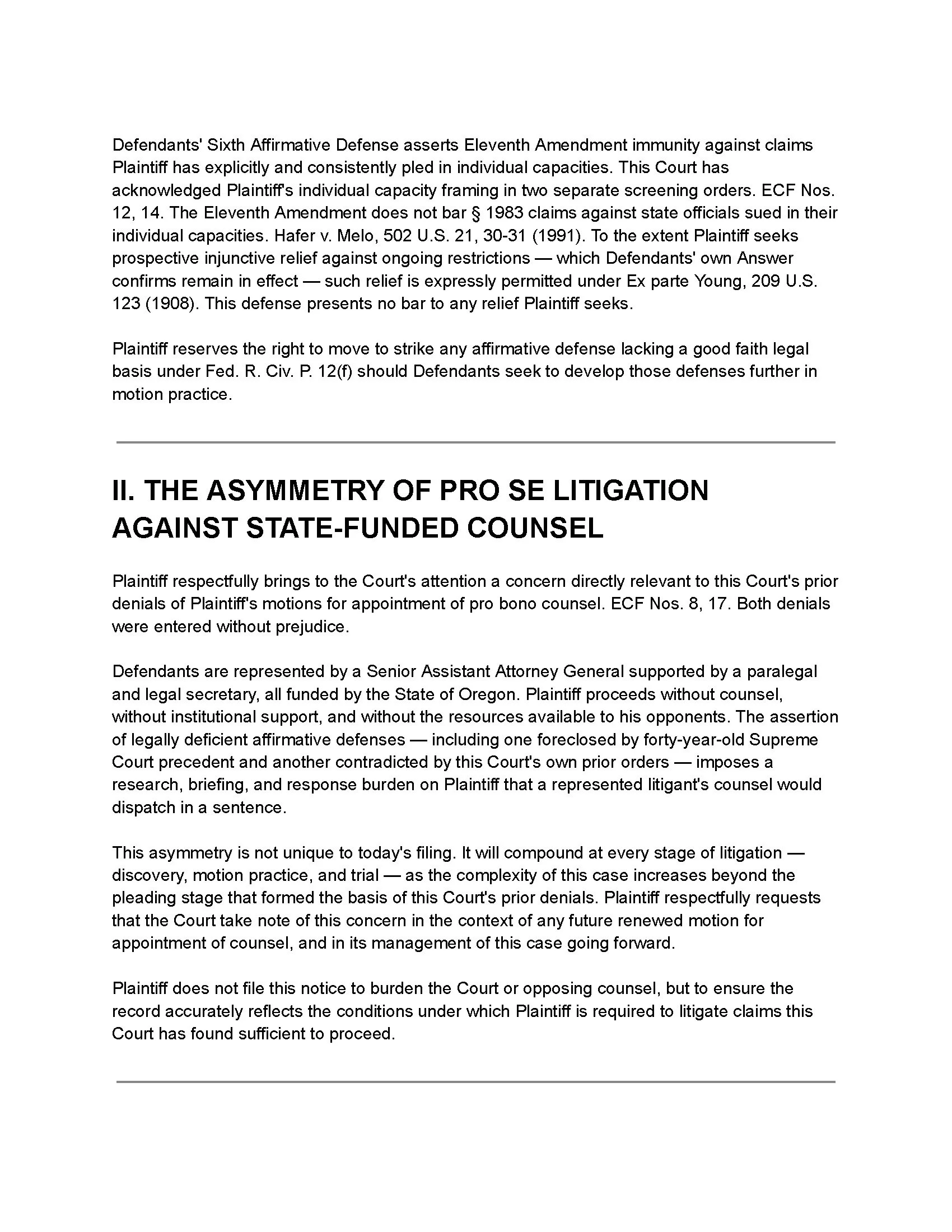
Plaintiff has explicitly and consistently pled in individual capacities. This Court has acknowledged Plaintiff's individual capacity framing in two separate screening orders. ECF Nos. 12, 14. The Eleventh Amendment does not bar § 1983 claims against state officials sued in their individual capacities. Hafer v. Melo, 502 U.S. 21, 30-31 (1991). To the extent Plaintiff seeks prospective injunctive relief against ongoing restrictions — which Defendants' own Answer confirms remain in effect — such relief is expressly permitted under Ex parte Young, 209 U.S. 123 (1908). This defense presents no bar to any relief Plaintiff seeks.
Plaintiff reserves the right to move to strike any affirmative defense lacking a good faith legal basis under Fed. R. Civ. P. 12(f) should Defendants seek to develop those defenses further in motion practice.
II. THE ASYMMETRY OF PRO SE LITIGATION AGAINST STATE-FUNDED COUNSEL
Plaintiff respectfully brings to the Court's attention a concern directly relevant to this Court's prior denials of Plaintiff's motions for appointment of pro bono counsel. ECF Nos. 8, 17. Both denials were entered without prejudice.
Defendants are represented by a Senior Assistant Attorney General supported by a paralegal and legal secretary, all funded by the State of Oregon. Plaintiff proceeds without counsel, without institutional support, and without the resources available to his opponents. The assertion of legally deficient affirmative defenses — including one foreclosed by forty-year-old Supreme Court precedent and another contradicted by this Court's own prior orders — imposes a research, briefing, and response burden on Plaintiff that a represented litigant's counsel would dispatch in a sentence.
This asymmetry is not unique to today's filing. It will compound at every stage of litigation — discovery, motion practice, and trial — as the complexity of this case increases beyond the pleading stage that formed the basis of this Court's prior denials. Plaintiff respectfully requests that the Court take note of this concern in the context of any future renewed motion for appointment of counsel, and in its management of this case going forward.
Plaintiff does not file this notice to burden the Court or opposing counsel, but to ensure the record accurately reflects the conditions under which Plaintiff is required to litigate claims this Court has found sufficient to proceed.