FAC Opinion and Order
Opinion and Order Images
Opinion and Order Text
MCSHANE, Judge:
Self-represented Plaintiff, Logan Martin Isaac, proceeding in forma pauperis ("IFP"), brought this action against Oregon legislators and legislative staff who allegedly deprived him of his constitutional rights. Compl., ECF No. 1. Following screening of his Complaint under 28 U.S.C. § 1915(e)(2)(B), Plaintiff filed a First Amended Complaint. FAC, ECF No. 9. For the reasons discussed below, Plaintiff's First Amended Complaint appears subject to dismissal in part.
BACKGROUND
The following allegations are drawn from the First Amended Complaint. Plaintiff Logan Martin Isaac is a resident of Albany, Oregon and is a disabled United States Army veteran. FAC 2. Since 2016, Plaintiff "has dedicated significant time and resources to advocating for military civil rights legislation." Id. at 3. Plaintiff is concerned about the prevalence of veteran suicide and believes there is a need for civil rights protections for veterans and military families. See id. at 4.
He has discussed military civil rights legislation with members of the Oregon Legislative Assembly, including Defendant Representative Davis, and advocated for proposed legislation that would strengthen protections for veterans and their families. Id. at 4.
On January 27, 2025, Plaintiff visited Representative Davis's office to follow up on the status of one such proposed law, "LC 2560." FAC 4. At a meeting with Defendant Perry, Plaintiff expressed frustration with the delays, commenting that "seventeen battle buddies are going to die today," referring to veteran suicide rates, and noted that his "next stop [was] going to be the Oregonian," a local newspaper. Id. at 4–5. Plaintiff states that Perry characterized Plaintiff's statement as a "threat," though Plaintiff alleges that he never made any threat of harm, violence, or unlawful conduct. Id. at 5. Defendant Perry threatened to call the police. Id. When Oregon State Police ("OSP") arrived, Representative Davis's staff members told officers "they did not view Plaintiff's conduct as rising to the level of requiring his removal from the premises." Id. When OSP officers offered to remove Plaintiff, Perry replied "No." Id. Representative Davis subsequently characterized the incident as "not acceptable." Id.
At the time, Senate Joint Memorial 1 ("SJM1") was pending before the Oregon legislature. FAC 6. "SJM1 urged Congress to conduct public hearings on anti-military bias and improve enforcement of hate-crime protections for military families." Id. (internal quotation marks omitted). On January 24, 2025, SJM1 was scheduled for hearing on January 28, 2025. Id. Following the Plaintiff's visit to Representative Davis's office on January 27, the "scheduled hearing was immediately canceled." Id. On February 5, 2025, SJM1 was "sent back to the president's desk for re-referral" to the Rules Committee. Id.
On February 7, 2025, Representative Davis issued a letter that banned Plaintiff from her office for one year, citing the January 27 incident. FAC 5. Two weeks later, on February 21, 2025, Plaintiff asserted his intent to continue his advocacy efforts despite Representative Davis's office ban, telling Representative Davis she had "no private authority to interfere with the rights guaranteed to Americans under the Constitution." Id. at 7. Later that day, Legislative Administrator Brett Hanes[1] issued a memo stating that Plaintiff's "visits to the Capitol have caused alarm, disruption and concern," and requiring Plaintiff to give advance notice to OSP and have an escort when visiting the State Capitol. Id. at 7 (internal quotation marks omitted).
One week later, on February 28, 2025, Plaintiff saw Matt Keating, a Senior Policy Advisor to Defendant Senator Manning, at a restaurant in Salem, Oregon. Id. at 7. Plaintiff filmed himself confronting Keating as he expressed frustration that hearings were not being scheduled for the bills he supported, and Keating stated he was "just waiting for [his] lunch." Id. at 8 (internal quotation marks omitted). Plaintiff published the video and later Senator Manning refused to schedule any hearings for a bill Plaintiff supported, "SB 1057," which "effectively kill[ed] the military civil rights legislation." Id. Plaintiff alleges Senator Manning admitted that he refused to schedule a hearing on SB 1057, because "[Keating] was confronted in a restaurant by the bill requestor with a video camera." Id. (internal quotation marks omitted). Plaintiff alleges that the actions of Representative David, Senator Manning, and their staff members amount to a conspiracy to retaliate against him for his advocacy and discriminate against him based on his status as a veteran. Id. at 9–10.
Plaintiff filed multiple "small claims actions" related to the underlying events in this case. FAC 9. He alleges that Defendant Maile, an Assistant Attorney General for the State of Oregon, made misrepresentations in communicating with Plaintiff about his case and interfered with Plaintiff's ability to obtain discovery for his claims. Id.
LEGAL STANDARD
Pursuant to 28 U.S.C. § 1915(e)(2)(B), the court must screen the complaint to determine whether the plaintiff has raised a cognizable legal claim. See, e.g., O'Neal v. Price, 531 F.3d 1146, 1151 (9th Cir. 2008). "[T]he court shall dismiss the case at any time if the court determines that" the action "is frivolous or malicious," "fails to state a claim on which relief may be granted," or "seeks monetary relief against a defendant who is immune from such relief." § 1915(e)(2)(B). The Court liberally construes pleadings by self-represented plaintiffs. Karim-Panahi v. Los Angeles Police Dep't, 839 F.2d 621, 623 (9th Cir. 1988). The Court applies the same standard it applies to a motion to dismiss under Federal Rule of Civil Procedure 12(b)(6) to assess whether the complaint states a claim. Watison v. Carter, 668 F.3d 1108, 1112 (9th Cir. 2012). To survive a motion to dismiss under the federal pleading standards, the complaint must include a short and plain statement of the claim and "contain sufficient factual matter, accepted as true, to 'state a claim to relief that is plausible on its face.'" Ashcroft v. Iqbal, 556 U.S. 662, 678 (2009) (quoting Bell Atl. Corp. v. Twombly, 550 U.S. 544, 570 (2007)). "A claim has facial plausibility when the plaintiff pleads factual content that allows the court to draw the reasonable inference that the defendant is liable for the misconduct alleged. The plausibility standard . . . asks for more than a sheer possibility that a defendant has acted unlawfully." Id. (internal citation omitted). The Court is not required to accept legal conclusions, unsupported by alleged facts, as true. Iqbal, 556 U.S. at 678.
DISCUSSION
Liberally construing Plaintiff's FAC, Plaintiff may have viable, non-frivolous claims. Other claims appear subject to dismissal, as explained below.
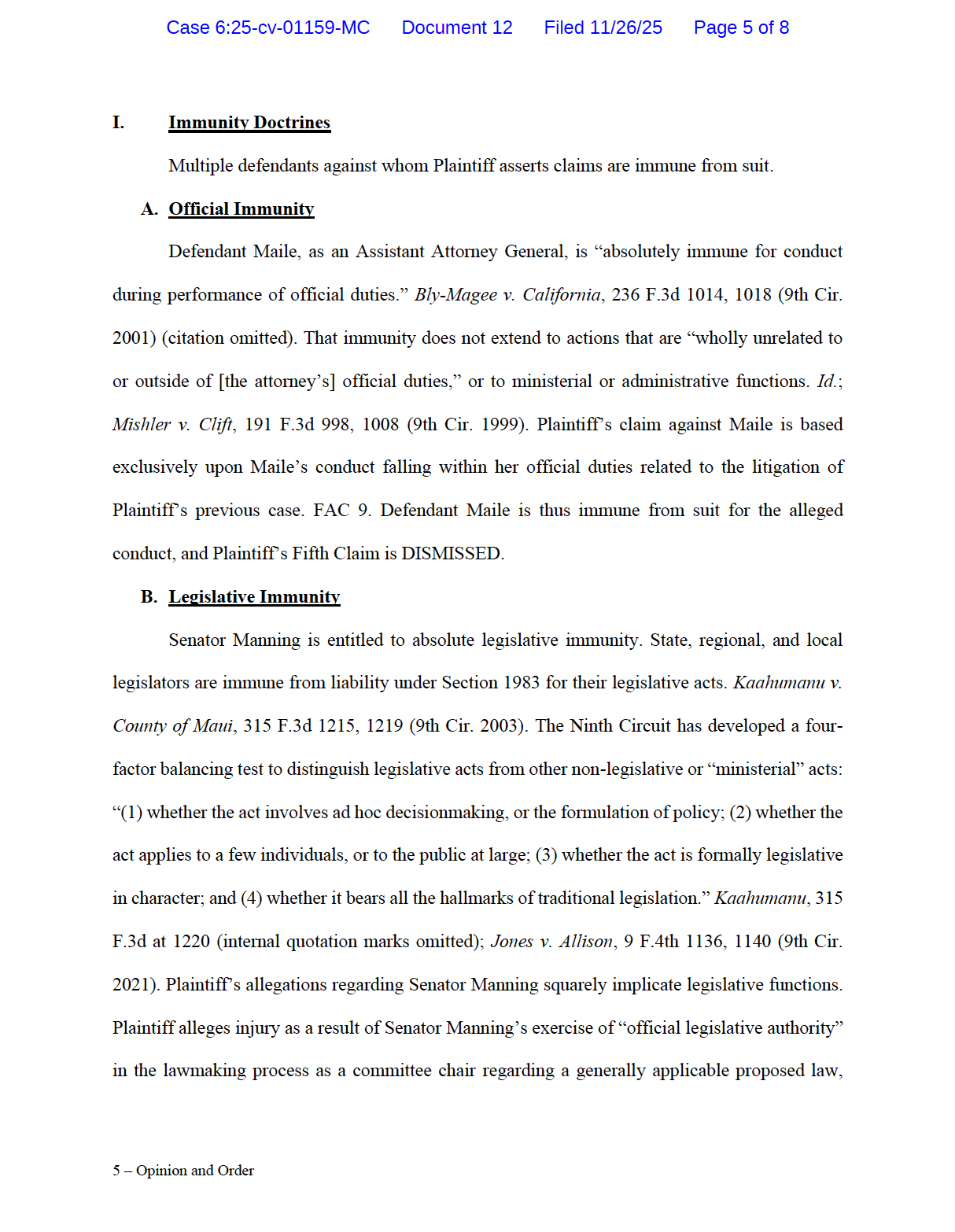
I. Immunity Doctrines
Multiple defendants against whom Plaintiff asserts claims are immune from suit.
A. Official Immunity
Defendant Maile, as an Assistant Attorney General, is "absolutely immune for conduct during performance of official duties." Bly-Magee v. California, 236 F.3d 1014, 1018 (9th Cir. 2001) (citation omitted). That immunity does not extend to actions that are "wholly unrelated to or outside of [the attorney's] official duties," or to ministerial or administrative functions. Id.; Mishler v. Clift, 191 F.3d 998, 1008 (9th Cir. 1999). Plaintiff's claim against Maile is based exclusively upon Maile's conduct falling within her official duties related to the litigation of Plaintiff's previous case. FAC 9. Defendant Maile is thus immune from suit for the alleged conduct, and Plaintiff's Fifth Claim is DISMISSED.
B. Legislative Immunity
Senator Manning is entitled to absolute legislative immunity. State, regional, and local legislators are immune from liability under Section 1983 for their legislative acts. Kaahumanu v. County of Maui, 315 F.3d 1215, 1219 (9th Cir. 2003). The Ninth Circuit has developed a four-factor balancing test to distinguish legislative acts from other non-legislative or "ministerial" acts: "(1) whether the act involves ad hoc decisionmaking, or the formulation of policy; (2) whether the act applies to a few individuals, or to the public at large; (3) whether the act is formally legislative in character; and (4) whether it bears all the hallmarks of traditional legislation." Kaahumanu, 315 F.3d at 1220 (internal quotation marks omitted); Jones v. Allison, 9 F.4th 1136, 1140 (9th Cir. 2021). Plaintiff's allegations regarding Senator Manning squarely implicate legislative functions. Plaintiff alleges injury as a result of Senator Manning's exercise of "official legislative authority" in the lawmaking process as a committee chair regarding a generally applicable proposed law, SB 1057. FAC 7–8, 11. Defendant Senator Manning is thus immune from suit for his legislative conduct, and Plaintiff's Second Claim is DISMISSED.
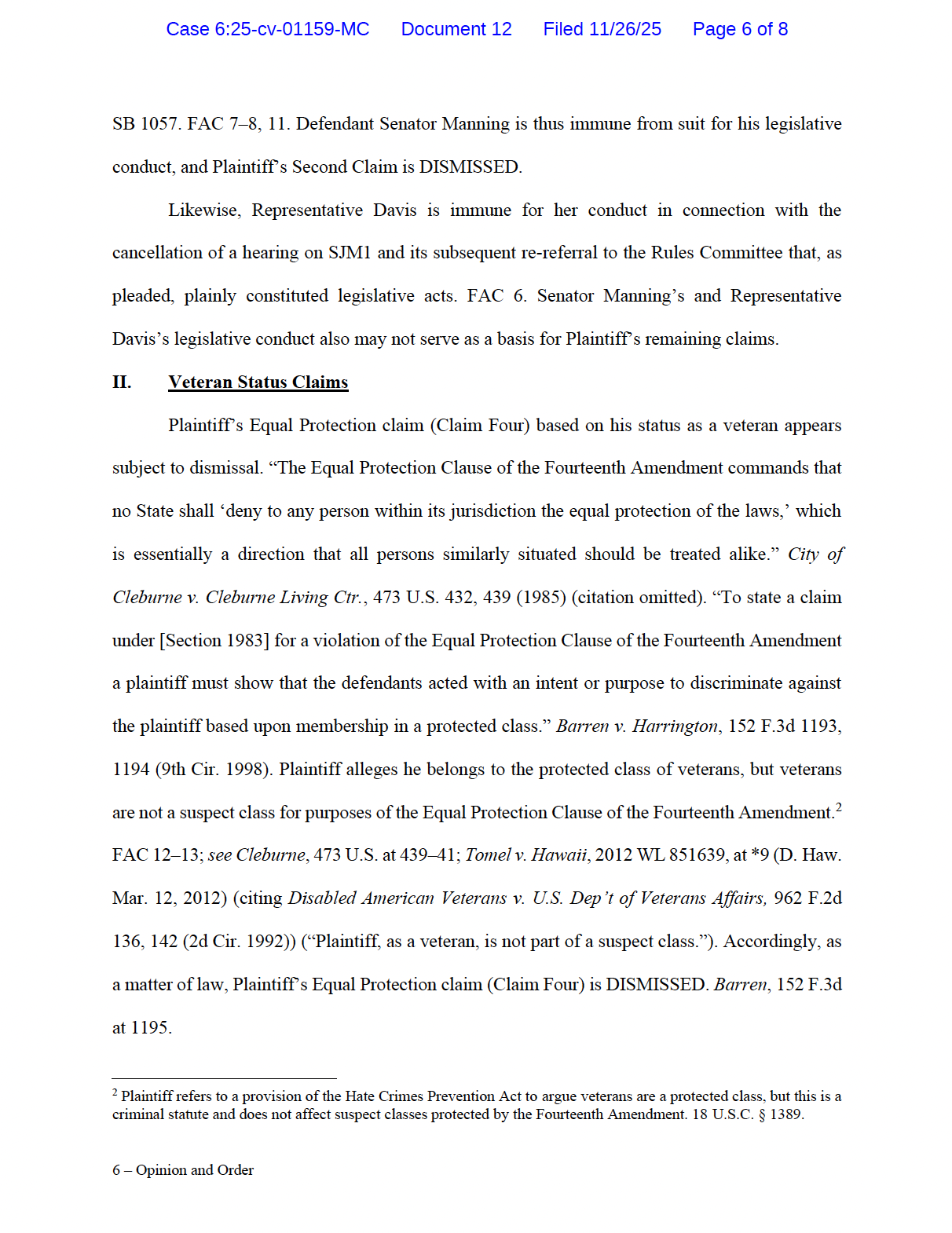
Likewise, Representative Davis is immune for her conduct in connection with the cancellation of a hearing on SJM1 and its subsequent re-referral to the Rules Committee that, as pleaded, plainly constituted legislative acts. FAC 6. Senator Manning's and Representative Davis's legislative conduct also may not serve as a basis for Plaintiff's remaining claims.
II. Veteran Status Claims
Plaintiff's Equal Protection claim (Claim Four) based on his status as a veteran appears subject to dismissal. "The Equal Protection Clause of the Fourteenth Amendment commands that no State shall 'deny to any person within its jurisdiction the equal protection of the laws,' which is essentially a direction that all persons similarly situated should be treated alike." City of Cleburne v. Cleburne Living Ctr., 473 U.S. 432, 439 (1985) (citation omitted). "To state a claim under [Section 1983] for a violation of the Equal Protection Clause of the Fourteenth Amendment a plaintiff must show that the defendants acted with an intent or purpose to discriminate against the plaintiff based upon membership in a protected class." Barren v. Harrington, 152 F.3d 1193, 1194 (9th Cir. 1998). Plaintiff alleges he belongs to the protected class of veterans, but veterans are not a suspect class for purposes of the Equal Protection Clause of the Fourteenth Amendment.[2] FAC 12–13; see Cleburne, 473 U.S. at 439–41; Tomel v. Hawaii, 2012 WL 851639, at *9 (D. Haw. Mar. 12, 2012) (citing Disabled American Veterans v. U.S. Dep't of Veterans Affairs, 962 F.2d 136, 142 (2d Cir. 1992)) ("Plaintiff, as a veteran, is not part of a suspect class."). Accordingly, as a matter of law, Plaintiff's Equal Protection claim (Claim Four) is DISMISSED. Barren, 152 F.3d at 1195.
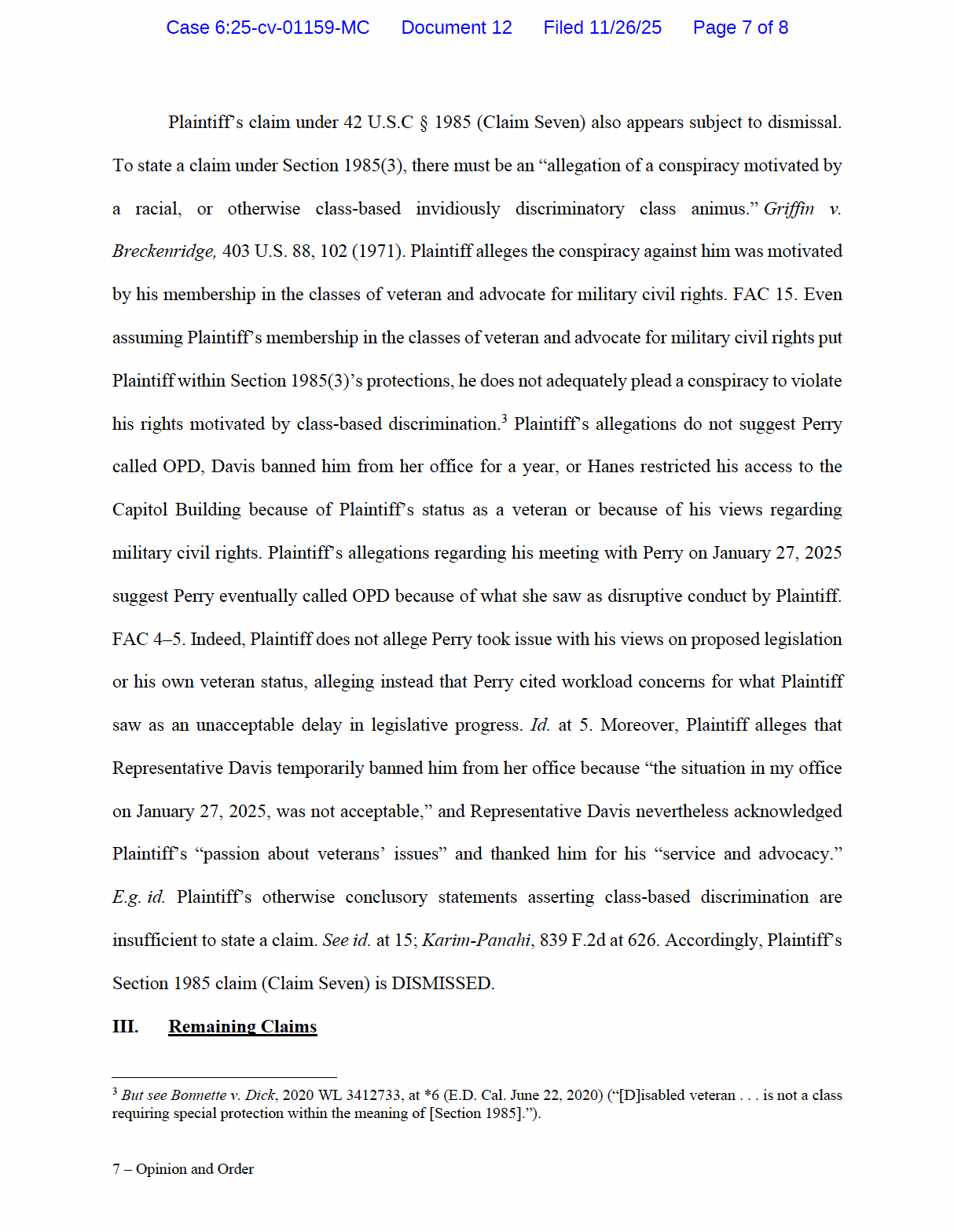
Plaintiff's claim under 42 U.S.C § 1985 (Claim Seven) also appears subject to dismissal. To state a claim under Section 1985(3), there must be an "allegation of a conspiracy motivated by a racial, or otherwise class-based invidiously discriminatory class animus." Griffin v. Breckenridge, 403 U.S. 88, 102 (1971). Plaintiff alleges the conspiracy against him was motivated by his membership in the classes of veteran and advocate for military civil rights. FAC 15. Even assuming Plaintiff's membership in the classes of veteran and advocate for military civil rights put Plaintiff within Section 1985(3)'s protections, he does not adequately plead a conspiracy to violate his rights motivated by class-based discrimination.[3] Plaintiff's allegations do not suggest Perry called OPD, Davis banned him from her office for a year, or Hanes restricted his access to the Capitol Building because of Plaintiff's status as a veteran or because of his views regarding military civil rights. Plaintiff's allegations regarding his meeting with Perry on January 27, 2025 suggest Perry eventually called OPD because of what she saw as disruptive conduct by Plaintiff. FAC 4–5. Indeed, Plaintiff does not allege Perry took issue with his views on proposed legislation or his own veteran status, alleging instead that Perry cited workload concerns for what Plaintiff saw as an unacceptable delay in legislative progress. Id. at 5. Moreover, Plaintiff alleges that Representative Davis temporarily banned him from her office because "the situation in my office on January 27, 2025, was not acceptable," and Representative Davis nevertheless acknowledged Plaintiff's "passion about veterans' issues" and thanked him for his "service and advocacy." E.g. id. Plaintiff's otherwise conclusory statements asserting class-based discrimination are insufficient to state a claim. See id. at 15; Karim-Panahi, 839 F.2d at 626. Accordingly, Plaintiff's Section 1985 claim (Claim Seven) is DISMISSED.
III. Remaining Claims
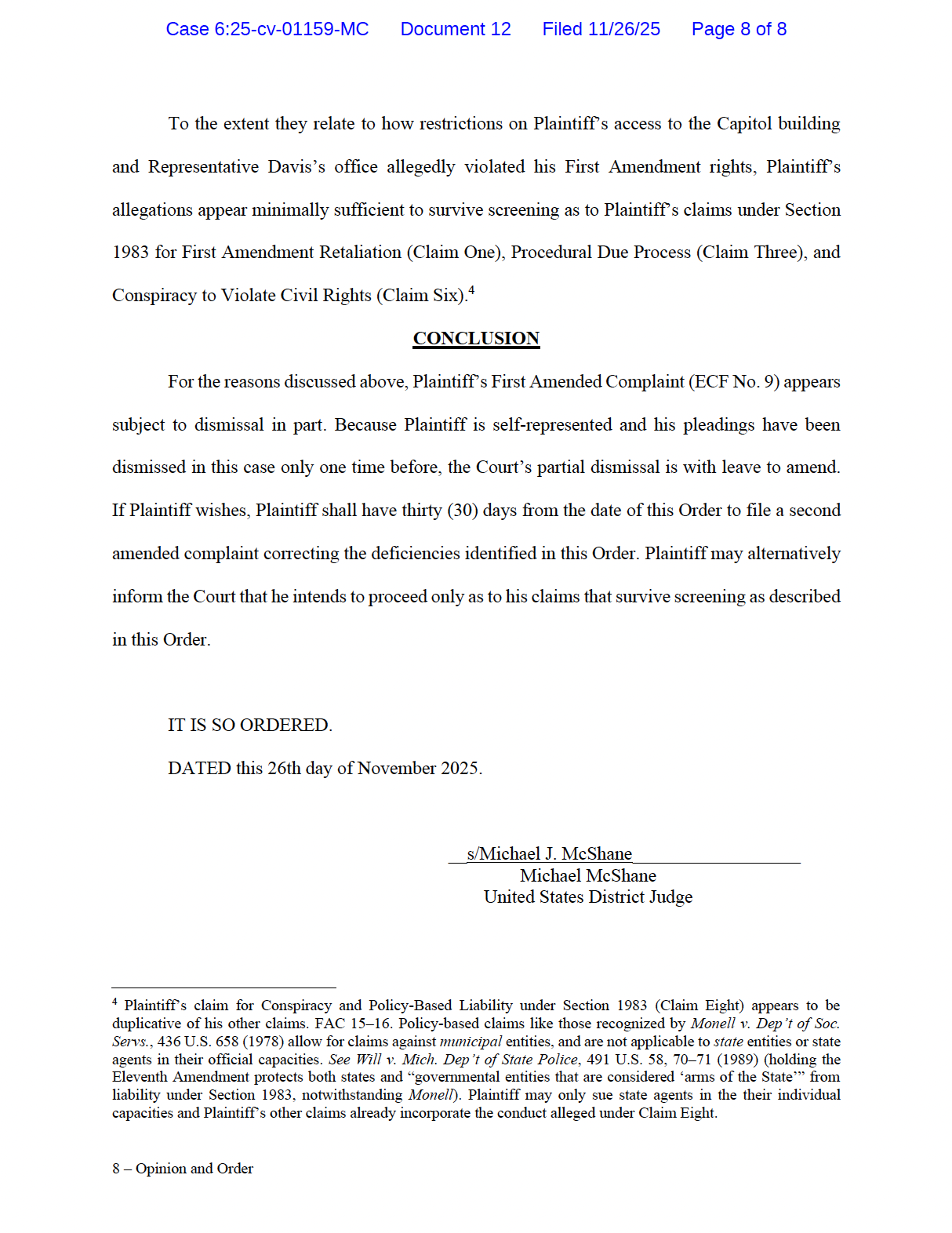
To the extent they relate to how restrictions on Plaintiff's access to the Capitol building and Representative Davis's office allegedly violated his First Amendment rights, Plaintiff's allegations appear minimally sufficient to survive screening as to Plaintiff's claims under Section 1983 for First Amendment Retaliation (Claim One), Procedural Due Process (Claim Three), and Conspiracy to Violate Civil Rights (Claim Six).[4]
CONCLUSION
For the reasons discussed above, Plaintiff's First Amended Complaint (ECF No. 9) appears subject to dismissal in part. Because Plaintiff is self-represented and his pleadings have been dismissed in this case only one time before, the Court's partial dismissal is with leave to amend. If Plaintiff wishes, Plaintiff shall have thirty (30) days from the date of this Order to file a second amended complaint correcting the deficiencies identified in this Order. Plaintiff may alternatively inform the Court that he intends to proceed only as to his claims that survive screening as described in this Order.
IT IS SO ORDERED.
NOTES
[1] Plaintiff states Hanes may be "potentially" included as a Doe Defendant. FAC 2.
[2] Plaintiff refers to a provision of the Hate Crimes Prevention Act to argue veterans are a protected class, but this is a criminal statute and does not affect suspect classes protected by the Fourteenth Amendment. 18 U.S.C. § 1389.
[3] But see Bonnette v. Dick, 2020 WL 3412733, at *6 (E.D. Cal. June 22, 2020) ("[D]isabled veteran . . . is not a class requiring special protection within the meaning of [Section 1985].").
[4] Plaintiff's claim for Conspiracy and Policy-Based Liability under Section 1983 (Claim Eight) appears to be duplicative of his other claims. FAC 15–16. Policy-based claims like those recognized by Monell v. Dep't of Soc. Servs., 436 U.S. 658 (1978) allow for claims against municipal entities, and are not applicable to state entities or state agents in their official capacities. See Will v. Mich. Dep't of State Police, 491 U.S. 58, 70–71 (1989) (holding the Eleventh Amendment protects both states and "governmental entities that are considered 'arms of the State'" from liability under Section 1983, notwithstanding Monell). Plaintiff may only sue state agents in the their individual capacities and Plaintiff's other claims already incorporate the conduct alleged under Claim Eight.