Second Amended Complaint (SAC)
SAC Images
SAC Text
COMES NOW Plaintiff Logan Martin Isaac, appearing pro se and in forma pauperis, and submits this Second Amended Complaint pursuant to the Court's November 26, 2025 Opinion and Order (ECF No. 12), which granted leave to amend identified deficiencies.
I. INTRODUCTION
This is a civil rights action under 42 U.S.C. § 1983 challenging coordinated retaliatory actions by Oregon state legislators, legislative staff, and other state officials who acted jointly to suppress Plaintiff's First Amendment petitioning activity and to exclude him from meaningful political participation.
Plaintiff seeks declaratory relief, prospective injunctive relief under Ex parte Young against state officials enforcing unconstitutional restrictions, and compensatory and punitive damages against individual defendants acting under color of state law.
Plaintiff asserts claims for: a. First Amendment retaliation; b. Fourteenth Amendment procedural due process violations; c. Conspiracy under § 1983 to violate federal rights.
II. JURISDICTION AND VENUE
This Court has jurisdiction under 28 U.S.C. §§ 1331 and 1343.
Venue is proper under 28 U.S.C. § 1391(b).
III. PARTIES
Plaintiff Logan Martin Isaac is a disabled United States Army veteran and resident of Albany, Oregon, within Oregon's 15th House District.
Defendant Senator James I. Manning, Jr. is Chair of the Oregon Senate Committee on Veterans, Emergency Management, Federal and World Affairs, and is sued in his individual capacity and his official capacity for purposes of prospective injunctive relief.
Defendant Representative Shelly Boshart Davis represents the 15th District of the Oregon House of Representatives and is sued in her individual capacity and her official capacity for prospective injunctive relief.
Defendant Renee Perry is Chief of Staff to Defendant Davis and acted under color of state law at all relevant times.
Defendants John and Jane Does 1-10 include state actors such as the Legislative Administrator, Oregon State Police personnel, and officials within the Oregon Department of Justice whose identities are not yet known. They are sued in their individual capacities, and, where applicable, in official capacity for prospective injunctive relief.
IV. STATEMENTS OF FACT
Plaintiff's Advocacy
Plaintiff has advocated for federal military civil rights and enforcement of 18 U.S.C § 1389 since 2019, and for state legislation starting in 2024.
Plaintiff has worked with multiple legislators on LC 2560 (later SB 1057) and Senate Joint Memorial 1 (SJM1), focused on both state and federal military civil rights.
January 27, 2025: Plaintiff's Office Visits and Immediate Retaliation
On January 27, 2025, Plaintiff visited Representative Davis's office to follow up on LC 2560.
Plaintiff expressed frustration with legislative delays and stated that "seventeen battle buddies are going to die today," a reference to veteran suicide rates.
Plaintiff also stated his intention to seek press coverage ("my next stop is going to be the Oregonian"), which is core First Amendment activity.
Plaintiff made no threats and committed no disruptive conduct.
Defendant Perry nevertheless characterized Plaintiff as a "threat," but when Oregon State Police arrived, Perry explicitly told OSP that she did not believe Plaintiff should be removed.
Plaintiff possesses audio confirming Perry's statements, which will be produced in discovery.
After leaving Representative Davis's office, Plaintiff proceeded to Senator Manning's office, accompanied by OSP Trooper Brian Kolacz, to confirm whether a Senate Veterans Committee hearing for SJM1 would be held on January 28, 2025. Senator Thatcher had confirmed the hearing would occur at 1 PM in Hearing Room B, though it was not posted on the public legislative calendar. Plaintiff explained he needed confirmation to prepare testimony and avoid either missing a scheduled hearing or appearing for a cancelled one. Manning's office never confirmed or denied the hearing. This meeting was peaceful and recorded by Trooper Kolacz. Doe defendants have refused to produce this recording despite multiple public records requests and have obstructed discovery of this evidence in related small claims proceedings.
Within hours of Plaintiff's visits to Davis and Manning, the hearing for SJM1 was abruptly canceled.
The proximity of these events, combined with the simultaneous withdrawal of support from multiple governmental and political actors, supports a plausible inference of retaliatory coordination between Senator Manning, Representative Davis, and other individuals whose identities and specific roles in the conspiracy remain unknown to Plaintiff pending discovery.
February 7, 2025: Davis Issues Office Ban Without Due Process
On February 7, 2025, Davis issued a one-year ban prohibiting Plaintiff from entering her office.
Plaintiff received no notice, hearing, or opportunity to respond.
The ban contradicted Perry's own statements to OSP that Plaintiff was not threatening.
February 21, 2025: Coordinated Capitol-Wide Access Restrictions
On the morning of February 21, Plaintiff emailed Davis asserting that she had "no private authority" to interfere with constitutional rights.
Within hours, Legislative Administrator Brett Hanes (Doe 1) issued a Capitol-wide restriction requiring Plaintiff to notify OSP in advance and have an escort at all times.
The Hanes memo relied entirely on the January 27 incident—despite staff having previously stated the incident did not warrant removal.
These restrictions were imposed without any procedure, standards, or neutral review.
Upon information and belief, Representative Davis and other state officials coordinated to escalate restrictions in retaliation for Plaintiff's continued advocacy.
Senator Manning's Retaliatory Killing of SB 1057
On February 18, 2025, LC 2560 was introduced as a priority bill by Senator Kim Thatcher, becoming SB 1057, and was referred to Senator Manning's committee.
On February 28, 2025, Plaintiff encountered Senator Manning's senior policy advisor Matt Keating at a restaurant, recorded the public interaction, and posted it online.
Manning thereafter refused to schedule a hearing for SB 1057, effectively terminating the bill.
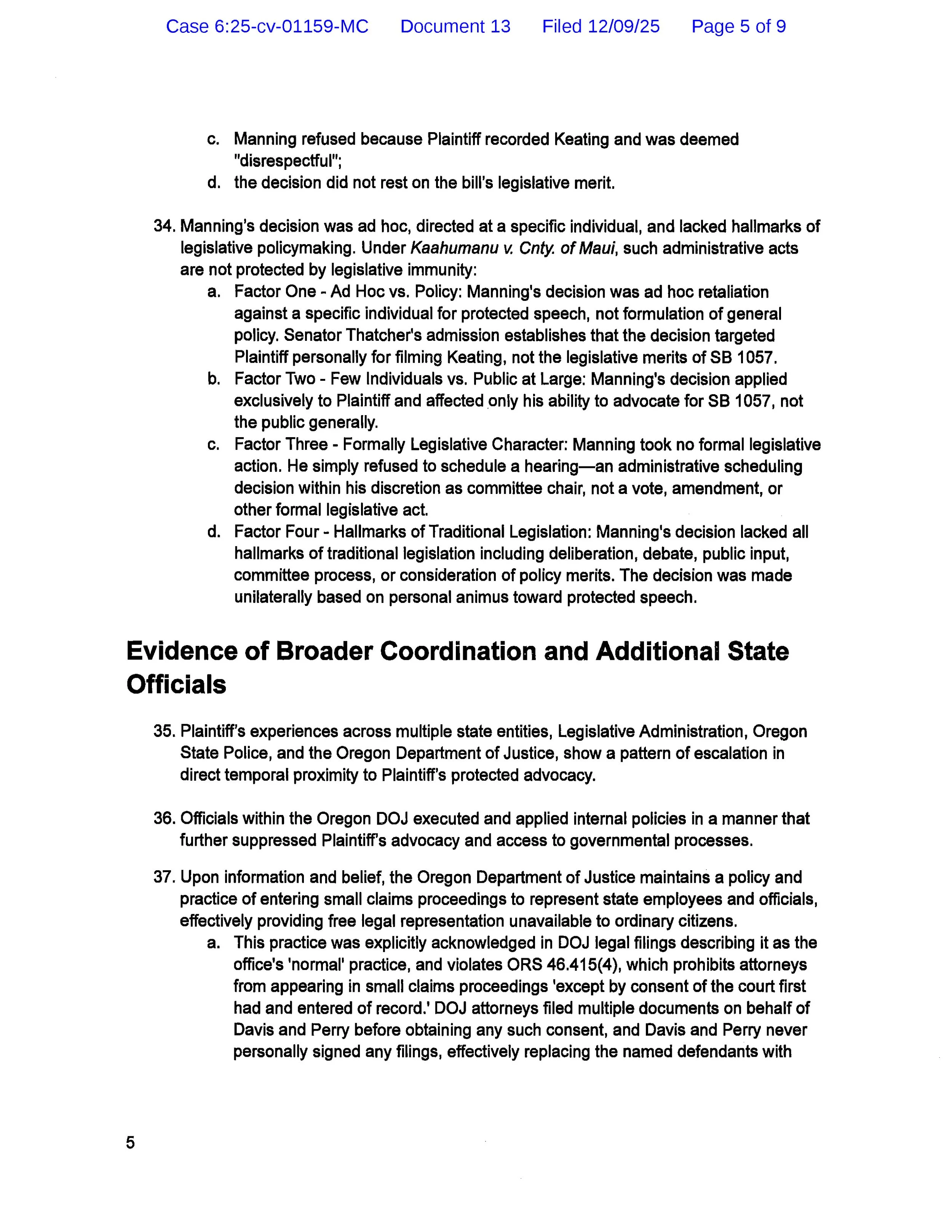
Thatcher, the Vice Chair of Manning's committee, communicated in writing that: a. she requested a hearing; b. the bill was one of her five "priority bills"; c. Manning refused because Plaintiff recorded Keating and was deemed "disrespectful"; d. the decision did not rest on the bill's legislative merit.
Manning's decision was ad hoc, directed at a specific individual, and lacked hallmarks of legislative policymaking. Under Kaahumanu v. Cnty. of Maui, such administrative acts are not protected by legislative immunity:
a. Factor One - Ad Hoc vs. Policy: Manning's decision was ad hoc retaliation against a specific individual for protected speech, not formulation of general policy. Senator Thatcher's admission establishes that the decision targeted Plaintiff personally for filming Keating, not the legislative merits of SB 1057.
b. Factor Two - Few Individuals vs. Public at Large: Manning's decision applied exclusively to Plaintiff and affected only his ability to advocate for SB 1057, not the public generally.
c. Factor Three - Formally Legislative Character: Manning took no formal legislative action. He simply refused to schedule a hearing—an administrative scheduling decision within his discretion as committee chair, not a vote, amendment, or other formal legislative act.
d. Factor Four - Hallmarks of Traditional Legislation: Manning's decision lacked all hallmarks of traditional legislation including deliberation, debate, public input, committee process, or consideration of policy merits. The decision was made unilaterally based on personal animus toward protected speech.
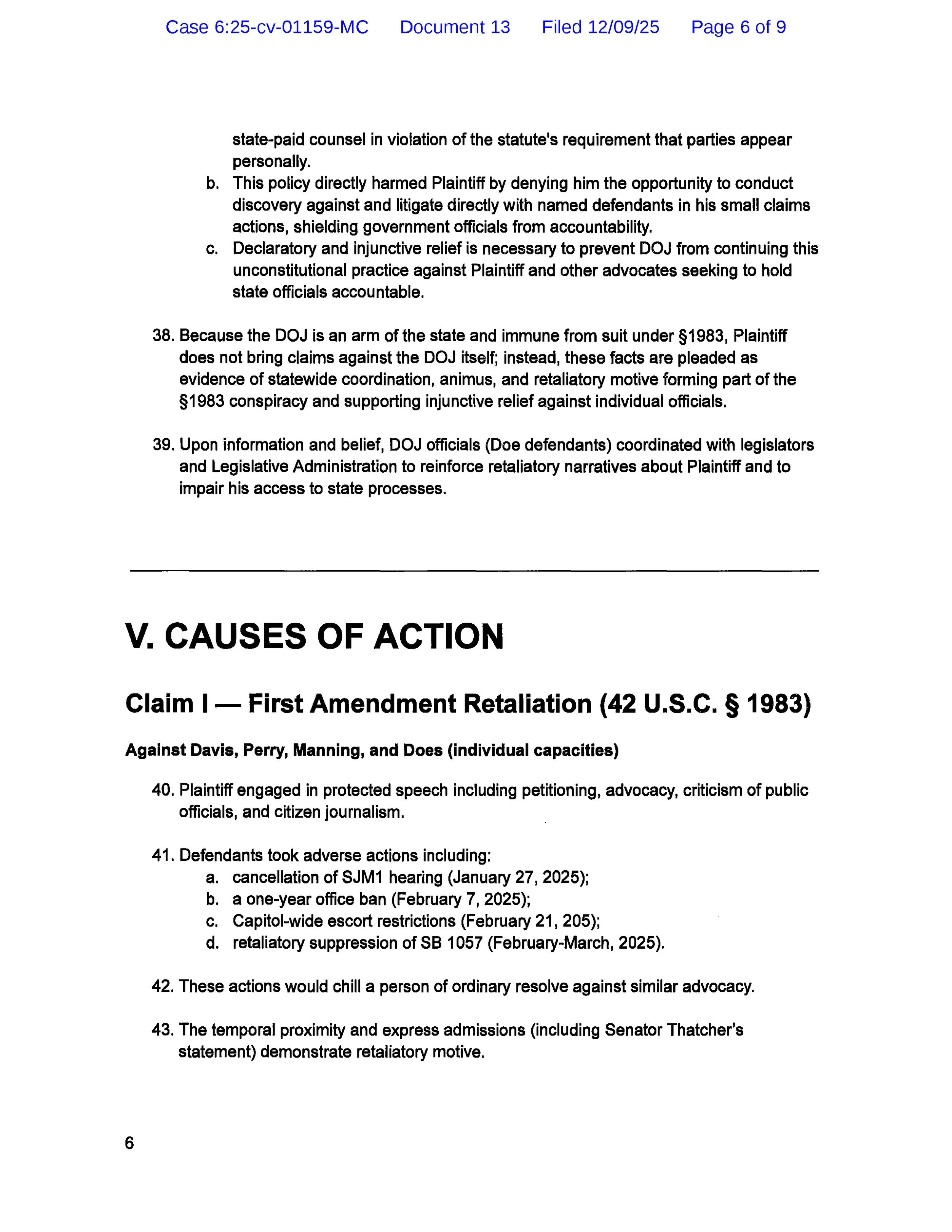
Evidence of Broader Coordination and Additional State Officials
Plaintiff's experiences across multiple state entities, Legislative Administration, Oregon State Police, and the Oregon Department of Justice, show a pattern of escalation in direct temporal proximity to Plaintiff's protected advocacy.
Officials within the Oregon DOJ executed and applied internal policies in a manner that further suppressed Plaintiff's advocacy and access to governmental processes.
Upon information and belief, the Oregon Department of Justice maintains a policy and practice of entering small claims proceedings to represent state employees and officials, effectively providing free legal representation unavailable to ordinary citizens.
a. This practice was explicitly acknowledged in DOJ legal filings describing it as the office's 'normal' practice, and violates ORS 46.415(4), which prohibits attorneys from appearing in small claims proceedings 'except by consent of the court first had and entered of record.' DOJ attorneys filed multiple documents on behalf of Davis and Perry before obtaining any such consent, and Davis and Perry never personally signed any filings, effectively replacing the named defendants with state-paid counsel in violation of the statute's requirement that parties appear personally.
b. This policy directly harmed Plaintiff by denying him the opportunity to conduct discovery against and litigate directly with named defendants in his small claims actions, shielding government officials from accountability.
c. Declaratory and injunctive relief is necessary to prevent DOJ from continuing this unconstitutional practice against Plaintiff and other advocates seeking to hold state officials accountable.
Because the DOJ is an arm of the state and immune from suit under §1983, Plaintiff does not bring claims against the DOJ itself; instead, these facts are pleaded as evidence of statewide coordination, animus, and retaliatory motive forming part of the §1983 conspiracy and supporting injunctive relief against individual officials.
Upon information and belief, DOJ officials (Doe defendants) coordinated with legislators and Legislative Administration to reinforce retaliatory narratives about Plaintiff and to impair his access to state processes.
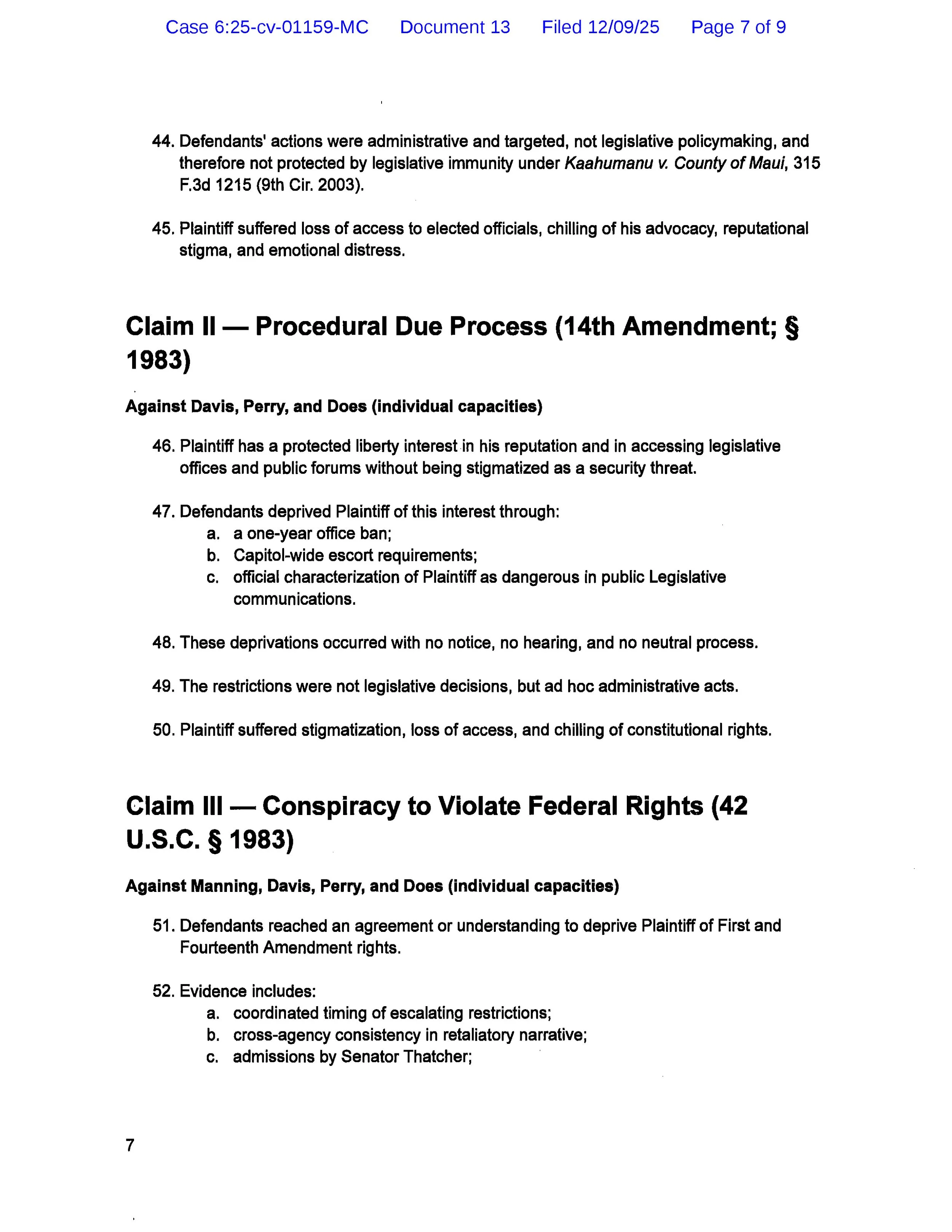
V. CAUSES OF ACTION
Claim I - First Amendment Retaliation (42 U.S.C. § 1983)
Against Davis, Perry, Manning, and Does (individual capacities)
Plaintiff engaged in protected speech including petitioning, advocacy, criticism of public officials, and citizen journalism.
Defendants took adverse actions including: a. cancellation of SJM1 hearing (January 27, 2025); b. a one-year office ban (February 7, 2025); c. Capitol-wide escort restrictions (February 21, 205); d. retaliatory suppression of SB 1057 (February-March, 2025).
These actions would chill a person of ordinary resolve against similar advocacy.
The temporal proximity and express admissions (including Senator Thatcher's statement) demonstrate retaliatory motive.
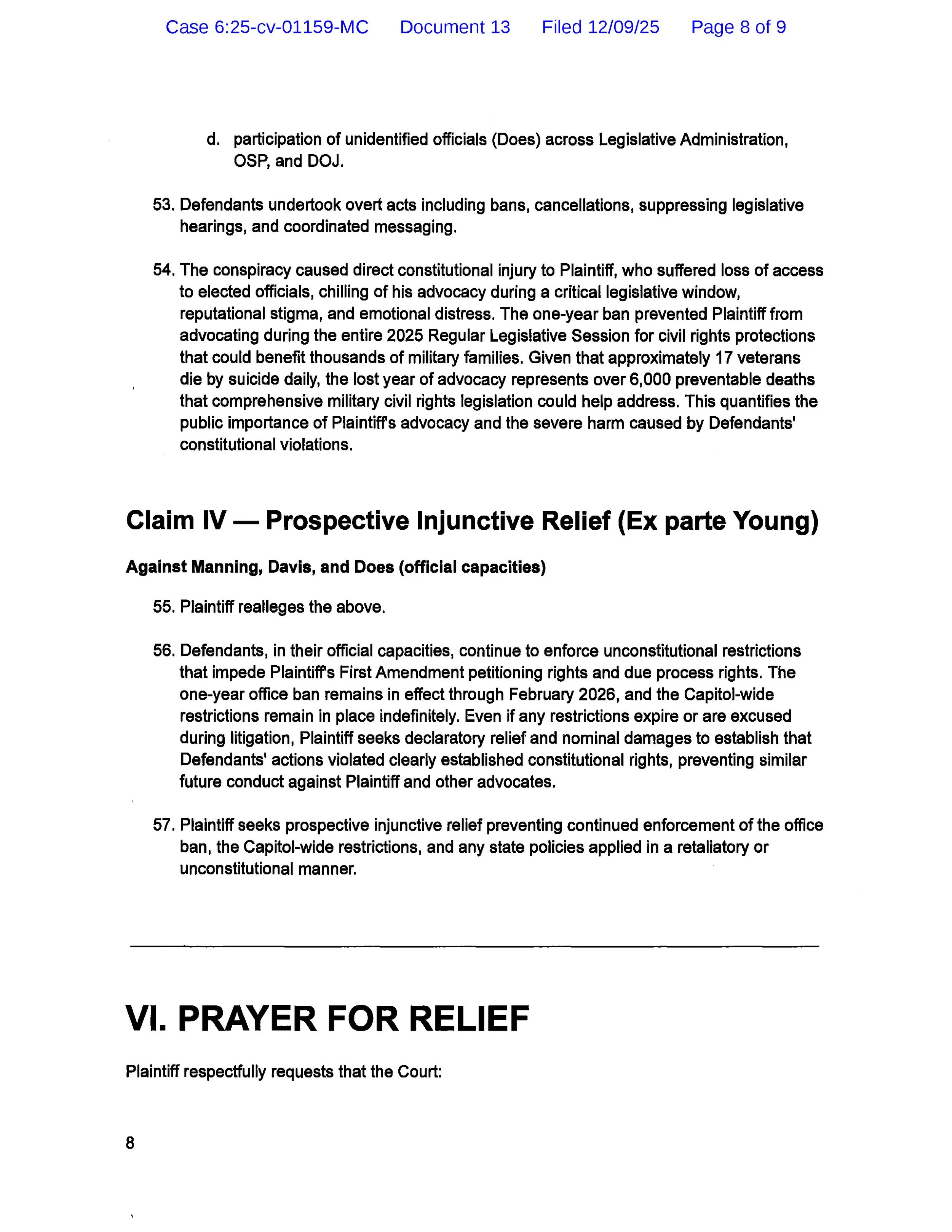
Defendants' actions were administrative and targeted, not legislative policymaking, and therefore not protected by legislative immunity under Kaahumanu v. County of Maui, 315 F.3d 1215 (9th Cir. 2003).
Plaintiff suffered loss of access to elected officials, chilling of his advocacy, reputational stigma, and emotional distress.
Claim II - Procedural Due Process (14th Amendment; § 1983)
Against Davis, Perry, and Does (individual capacities)
Plaintiff has a protected liberty interest in his reputation and in accessing legislative offices and public forums without being stigmatized as a security threat.
Defendants deprived Plaintiff of this interest through: a. a one-year office ban; b. Capitol-wide escort requirements; c. official characterization of Plaintiff as dangerous in public Legislative communications.
These deprivations occurred with no notice, no hearing, and no neutral process.
The restrictions were not legislative decisions, but ad hoc administrative acts.
Plaintiff suffered stigmatization, loss of access, and chilling of constitutional rights.
Claim III - Conspiracy to Violate Federal Rights (42 U.S.C. § 1983)
Against Manning, Davis, Perry, and Does (individual capacities)
Defendants reached an agreement or understanding to deprive Plaintiff of First and Fourteenth Amendment rights.
Evidence includes: a. coordinated timing of escalating restrictions; b. cross-agency consistency in retaliatory narrative; c. admissions by Senator Thatcher; d. participation of unidentified officials (Does) across Legislative Administration, OSP, and DOJ.
Defendants undertook overt acts including bans, cancellations, suppressing legislative hearings, and coordinated messaging.
The conspiracy caused direct constitutional injury to Plaintiff, who suffered loss of access to elected officials, chilling of his advocacy during a critical legislative window, reputational stigma, and emotional distress. The one-year ban prevented Plaintiff from advocating during the entire 2025 Regular Legislative Session for civil rights protections that could benefit thousands of military families. Given that approximately 17 veterans die by suicide daily, the lost year of advocacy represents over 6,000 preventable deaths that comprehensive military civil rights legislation could help address. This quantifies the public importance of Plaintiff's advocacy and the severe harm caused by Defendants' constitutional violations.
Claim IV - Prospective Injunctive Relief (Ex parte Young)
Against Manning, Davis, and Does (official capacities)
Plaintiff realleges the above.
Defendants, in their official capacities, continue to enforce unconstitutional restrictions that impede Plaintiff's First Amendment petitioning rights and due process rights. The one-year office ban remains in effect through February 2026, and the Capitol-wide restrictions remain in place indefinitely. Even if any restrictions expire or are excused during litigation, Plaintiff seeks declaratory relief and nominal damages to establish that Defendants' actions violated clearly established constitutional rights, preventing similar future conduct against Plaintiff and other advocates.
Plaintiff seeks prospective injunctive relief preventing continued enforcement of the office ban, the Capitol-wide restrictions, and any state policies applied in a retaliatory or unconstitutional manner.
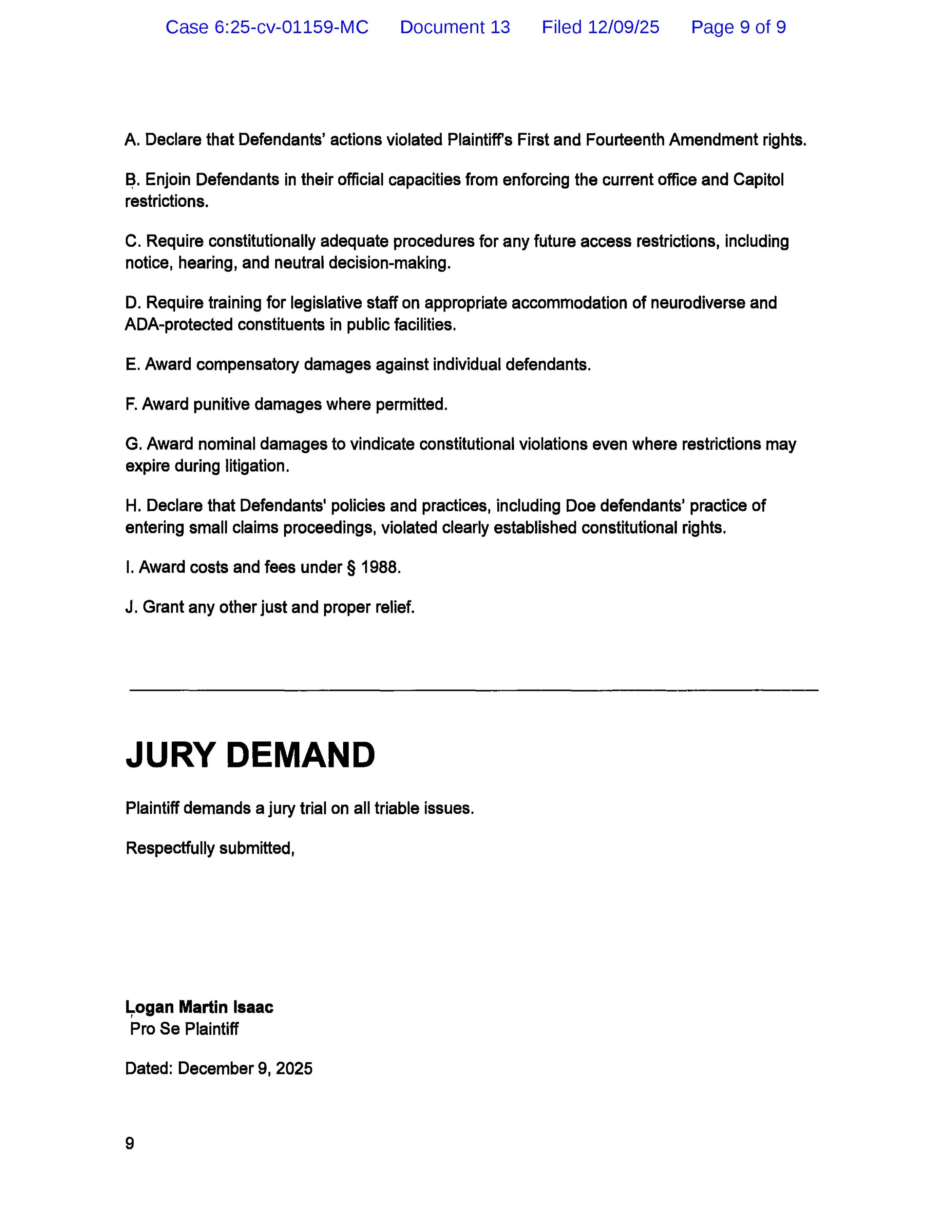
VI. PRAYER FOR RELIEF
Plaintiff respectfully requests that the Court:
A. Declare that Defendants' actions violated Plaintiff's First and Fourteenth Amendment rights.
B. Enjoin Defendants in their official capacities from enforcing the current office and Capitol restrictions.
C. Require constitutionally adequate procedures for any future access restrictions, including notice, hearing, and neutral decision-making.
D. Require training for legislative staff on appropriate accommodation of neurodiverse and ADA-protected constituents in public facilities.
E. Award compensatory damages against individual defendants.
F. Award punitive damages where permitted.
G. Award nominal damages to vindicate constitutional violations even where restrictions may expire during litigation.
H. Declare that Defendants' policies and practices, including Doe defendants' practice of entering small claims proceedings, violated clearly established constitutional rights.
I. Award costs and fees under § 1988.
J. Grant any other just and proper relief.
JURY DEMAND
Plaintiff demands a jury trial on all triable issues.
Respectfully submitted,
Logan Martin Isaac
Pro Se Plaintiff
Dated: December 9, 2025